Click on photos to enlarge.

Wednesday, November 7, 2012

New American Painting

The 1958 New American Painting
exhibition catalogue
In 1958, the Museum of Modern Art organized an exhibition of first-generation Abstract Expressionists under the title "The New American Painting". They sent it on tour to some eight European capitals where the paintings were well received. The title, however, was not. There were growing suspicions that it wasn't, in fact, "new". Art critic Harold Rosenberg summed it up succinctly: "Today it is felt that a new art mode is long overdue, if for no other reason than the present avant-garde has been with us for fifteen years... No innovated style can survive that long without losing its radical nerve and turning into an Academy." He dismissed second-generation Abstract Expressionists as "method actors", having lost any innovative edge.


Girl on the Beach, 1954,
Richard Diebenkorn
The question of what was to replace Abstract Expressionism found a whole host of candidates waiting in the wings. Pop Art emerged, as did Minimalism, but so did representational art and in particular, a sort of rediscovery of "the figure". Two artists came forward to lead this renaissance--Richard Diebenkorn, and Philip Pearlstein. Diebenkorn (1922-1993) had, at one time, been an Abstractionist, teaching at the California School of Fine Arts where he was influenced by his colleagues Mark Rothko and Clyfford Still. However, by the mid-fifties he began to once more use a model, and though his work continued to bear abstractionist painting techniques, he was able to capture new emotional elements associated with his figures which seemed to him more universal than that he'd experienced with Abstract Expressionism. In doing so, he was accused to "caving in" to West Coast "provincial" tastes.
 
Models with Mirrors, 1956, Phillip Pearlstein

Philip Pearlstein (b. 1924), also fled Abstract Expressionism when it seemed to him to have lost it's edge. Over a period of several years, his paintings became more and more descriptive, eventually evolving into Photo-Realism. However, unlike Diebenkorn, any emotional attachment to his figures was often negated by his habit of hiding models heads or merely cropping them using the top edge of his canvases. The result was that his nude figures (often with less-than-ideal physical proportions), though extremely realistic, became mere compositional elements, often twisted, overlapped, or cropped in such a way as to not only eliminated any erotic overtones, but any individual identity as well. In these two artist we see one, returning to subjective painting but in an abstract style, while the other retained the strong compositional attachment of Abstraction but in a realistic mode.

Tuesday, November 6, 2012

Neo-Eclectic Style Architecture

Neo-Eclectic style architecture, AKA the McMansion.
Architects and art historians are not very good at naming things. They usually leave that to the critics who come up with highly visual names like Impressionism or Tudor, or Victorian, which, while useful and descriptive, at the same time leave a lot to be desired in terms of history. From an art-historian's point of view, what follows a popular style is often named "post" as in Post-Impressionism. Thus, in architecture (and also in painting) what followed Modern style architecture has been dubbed "Post-Modern." Unfortunately, these historian-driven titles, while fitting the history puzzle, tell us little about the style itself. Architecturally, the usually dependable critics in this case have come to call today's Post-modern housing, "Neo-eclectic," which really doesn't help much. So, what does this Neo-Eclectic, Post-Modern housing look like? The "Modern" style held sway until about the end of the 1960s or 70s when we drifted into Post-Modernism. One of the keynotes of the Post-Modern housing style is the "flavoring" or decorating of what had been relatively colorless Modern architecture by drawing upon subtle (usually) shadings of past styles with little regard for anything approaching authenticity.
 
If Neo-eclectic has a common thread, it is the multiplicity of forward facing gables,
here seen in a Craftsman Style flavor.
In studying it, we find this Neo-Eclectic, Post-Modern style actually consists of Neo-French, Neo-Tudor, Neo-Colonial, Neo-Mediterranean, Neo-Victorian, and very often, Neo-classical Revival (talk about a style wearing thin from overuse). Now we have terms that ring up images whereas Post-Modern or even Neo-eclectic don't. What really has occurred is that architects have taken to designing structures, then allowing the interior designers, who used to be limited to drapes, furniture, carpet, and accessories, to not only arrange rooms (or areas as we often refer to them now) but also to become exterior designers. It might seem hard to imagine, but you can now buy virtually the same floor plan in perhaps half a dozen different Neo-Eclectic styles. Like French? Fine, we'll add a mansard roof. Really like French? Okay, we'll add dramatically arched windows and a tall chimney too! How about something more colonial? Okay, scotch the arched windows, how about dormers instead, oh, and shutters--gotta have shutters to be colonial. TA DAAAA--instant Neo-Colonial.

All those Neo-Eclectic, forward-facing, gables often results in a very irregular
floor plan as seen here in the layout for the Craftsman Style house just above.
Such sprawling plans (even for relatively modest, 3-bedroom homes)
 demand sprawling lots leading to sprawling communities.
Note the Neo-Eclectic "two plus one" three-car garage.
It's a soda shop mentality applied to home design. Start with plain vanilla then flavor it with any of a half-dozen or so different "looks." I'm exaggerating a little, of course, but only a little. Each neo style does have some basic structural demands. Some are more symmetrical than others. Some work best as single story plans while others demand more verticality. Neo-Victorian not only demands two stories but also some diagonal walls, octogonalizing a room or two. Nearly all such designs like a lot of forward gables as seen in the home designs of the past twenty years. Some flavors look better with a narrow front, others with a broad street presentation. So it's not all just pure decoration; but in many cases it's hardly more than that. And curiously, the fallout from all this is that architects today seldom design Neo-Eclectic homes for individual clients anymore. When you see one of these homes (and it's hard not to in any recent housing development) you can bet they came from a plan book rather than being a one-of-a-kind creation, even in the case of the largest ones.

The Neo-Victorian flavor is alive and well, living under the broad, Neo-Eclectic roof.
Along side the "soda shop" flavorings, lingers the old post-war "cookie cutter" mentality, this time with a variety of different icings and "sprinkles." Of course each plan-book house is designed by an architect; and there are lots more "cookie cutters" than right after the war; but the affect is much the same. And that's where our three-century search for the American dream in housing architecture has brought us up until now. Have we come to the end of the rainbow? Have we "revivaled" and "neo-ed" ourselves right out of anything really new? Are we to be confronted next with perhaps Neo-Medieval, or Neo-Polynesian, or Neo-Native American as we search for the next new flavor of the month? Stay tuned. Next time we get into neo-prognostication!
Hey, I wasn't kidding about the Neo-Eclectic, Neo-Polynesian stuff.

Monday, November 5, 2012

Neglected Black Artists

The Progress of the American Negro, 1939-40, Charles White
For decades, African-American art has been the most neglected area of American Art. This neglect comes from two directions, one cultural, the other having to do with conservancy. It's no secret that African-American artists have traditionally been shut out of the mainstream of American art. There wasn't even a black mainstream as there was in baseball or music. African-American painting was largely done for self and family, and even in recent times, as the spotlight has grudgingly turned to the work of these long-neglected artists, the second factor often raised its ugly head. How can one appreciate the work of these artists if their work has been neglected to the point that they are unpresentable--often so caked with grime as to be practically unviewable? Signatures are indecipherable, and the content very nearly as obscure.

Lynching, 1936, Nat Werner
Jock Reynolds, direct of the Yale University Art Gallery, also wondered why there were so few minorities in the field of art conservation. With the backing of sponsors such as AT&T and The Ford Motor Company, he set out to remedy both areas of neglect. Working with students from several traditionally black schools he began working to teach them modern conservancy techniques while resurrecting the badly neglected work of dozens of African-American painters and sculptors. The work of such artists as muralist, Charles White, came to light as a huge, cracked and creased 1940 canvas was unrolled, cleaned, and displayed for the first time in over fifty years (top). Often, the work was not "pretty," even after it was cleaned. Such is the case with John Biggers' Old Coffee Drinker from 1945 or the 1936 wood sculpture of Nat Werner which graphically depicts the broken body of a lynched black man, neck broken, with a noose around it (left).


Conserved and preserved 


The result of the conservancy effort was the 1999 Harlem Studio Museum show, "To Conserve a Legacy", a 200-piece exhibit drawing from six historically black American educational institutions, art work, many of which had never been publicly exhibited before. There was the photography of Frances Benjamin Johnston (bottom), the first female press photographer, as well as work drawn from the collections of Booker T. Washington, Joseph Albers, Georgia O'Keefe, and her husband Alfred Stieglitz, all of whom collected early black artists. Some artists had been totally unknown, such as Thomas Waterman Wood, whose painting of a black freedman butler came to light only after cleaning revealed his signature. The show also included the work of somewhat better-known African-American artists such as Jacob Lawrence, Romare Bearden, Henry Tanner, and Horace Pippin.
Frances Benjamin Johnson Self-portrait, 1896
 

Sunday, November 4, 2012

Native American Art

Pequot tribal descendants reenact an encounter with early European settlers.
As we stuff ourselves with turkey and all the trimmings later this month, our thoughts have been trained to reflect back upon the New England Pilgrims and the first Thanksgiving of 1621. Although they've been an integral part of the Thanksgiving tradition for centuries, we don't as often contemplate those sitting on the other side of the table at that first Thanksgiving--the Native Americans. If this is true at Thanksgiving, it's all the more the case when we think about American art. In fact, I think it would be fair to say, in this context, we seldom, if ever, think about indigenous American Art. We think as if our European forebears had some kind of monopoly upon creative expression and exposition. But actually, art was so deeply ingrained in the culture of our Native American brothers and sisters it totally lacked the artificial separations European minds then and now are accustomed to. Native American art was a part of all that they were, from illustrated legends drawn in charcoal on the walls of subterranean caverns, to the clothes they wore, their weapons, their daily utensils, their religion, their painted bodies, even the way they laid out their communities.


Mashantucket Pequot Museum and Research Center,
Mashantucket, Connecticut.
Nowhere is this more eloquently depicted than at the Mashantucket Pequot Museum and Research Center at Mashantucket, Connecticut. The $193 million facility is, in a modern sense, more than an art museum, yet in the traditional sense I mentioned above, it's nothing but an art museum. It might better be termed a cultural showplace made possible by the 1983 settlement of land claims dating back nearly two hundred years; and by the sale of sand, gravel, maple syrup, vegetables from a hydroponic greenhouse, a restaurant, and of course, the real cash cow, their Foxwoods Resort Casino.

Pequot basketry, early to mid-19th century
The art of the Pequot is that of wood. Basketry, bowls, canoes, weapons, eating utensils, all center upon this most plentiful, malleable, and readily available art medium. Carved, woven, even painted upon, wood never achieved a higher calling in art than that of the Pequot. The museum includes hundreds of objects, from prehistoric tools to eighteenth century clubs to 20th century paintings. These are juxtaposed next to work by contemporary Native Americans such as two Penobscot artists who have depicted in wood sculpture the Abenaki creation story detailing how the first man and woman were carved from trees and came to life when shot with arrows.

Pequot art today, Quilled Box, 1996,
Vicky Sanipass
We don't know for sure which tribes shared the first Thanksgiving feast with their Puritan neighbors. The Pequot, the Penobscot, perhaps several others may have attended. But it's a pretty sure bet that they brought their "covered dish" share of the feast in bowls made of wood, served with utensils made of wood, perhaps transported in birch bark canoes. They may have marvelled at their hosts' fine china, or everyday pewter, maybe even traded for it, but the artistry and craftsmanship in their own offerings stood up quite easily next to that of the thankful Pilgrims.
 
Although the first Thanksgiving feast in 1621 seems to have been a peaceful
enough affair, later colonial Thanksgiving celebrations often followed
brutal massacres of "native savages."
 

Saturday, November 3, 2012

The National Arts Club

The National Arts Club, 15 Gramercy Park, New York
We who are not a part of it, frequently speak disparagingly of what we call the "art establishment." We have in our minds ultra liberal pinheads standing around a pile of artfully arranged bricks, or seemingly unarranged brushstrokes defiling an otherwise perfectly good hood of a 1948 Chrysler, while daintily sipping wine and noshing on cheese speared with a toothpick. We picture this upscale scene somewhere behind the art-deco doors of an ever-so-chic SOHO art gallery where prices for a painting of...well....okay, the card on the wall beside it says, "Disenfranchisement", where prices for such cutting-edge work begin at $10,000 (without frames) and can go as high as ten times that. This is an inaccurate stereotype. The real heart of the New York, liberal, establishment, art world is many blocks away, beyond the guarded gates of Gramercy Park, ensconced behind the locked doors of a nineteenth century brownstone mansion once belonging to a former governor of New York, Samuel J. Tilton.

The National Arts Club, a gallery installation dating from about 1914.
This ivory tower bastion of art conservancy is called the National Arts Club, and while it's probably not made of ivory, its beaux-art style home is joined to a twelve-story tower just behind it, housing resident studios for such currently well-known artists as Will Barnet, Chen Chi, Diana Kan, and Everett Raymond Kinstler. Founded in 1898 by a gentleman named Charles de Kay, an art and literary critic for the New York Times, the organization inspired a spirit of cultural nationalism that in its day made it the most innovative arts group in the country. De Kay was able to organize museum officials, dealers, writers, editors, and businessmen to work with artists such as Arthur B. Davies, William Glackens, Robert Henri, George Luks, Maurice Prendergast, and John Sloan; along with wealthy patrons such as Benjamin Altman, Samuel P. Avery, and Henry Clay Frick, to promote the exhibition and sales of work by American Artists.

A National Arts Club recent exhibit, the work of Swedish-born Peter Hammar.
Early exhibits of the National Arts Club included sculpture by Rodin, the first exhibition of Alfred Stieglitz's Photo-seccession, and the annual exhibits of the Women's Art Club. Not just limited to painting and sculpture, the organization also promotes the applied arts (crafts), industrial arts, as well as civic art and architecture. Its membership has always been open to both men and women and over the years, through its life-membership program, it has acquired a collection of American Art spanning a broad range of content and styles. Today, despite it's sheltered venue among the stuffy Victorian monuments to "cultured" living, it is both a repository of 20th century art, and a vibrant creative force to be reckoned with in the New York art world.
 
All too often, the National Arts Club exhibits are little more than backdrops for  those wishing to see and be seen with celebrities, here: Nancy Rhodes, Lucie Arnaz, Sheldon Harnick, Marvin Hamlisch, Karen Ziemba, and Daniel De Siena.

Friday, November 2, 2012

Mythology Rediscovered


Danae, 1907-08, Gustave Klimt
Yesterday (previous item, below), I may have given the impression that painting traditional mythology has become largely a thing of the past, and at best, what little that's being done today is mostly "crap." If so, that was not my intention nor is such an impression totally accurate. Having said that, I also have to say, I don't know of a single painter today who routinely paints mythology. Of course, there probably are some, but such work has a very limited audience and even less marketing potential (unless you consider what's called "fantasy" painting to be mythology). However, much as we might think otherwise, mythological painting did not die with the passing of Academicism and the coming of age of Modern Art. It did, however, recede for some fifty years. The Impressionists, and particularly those directly following them, preferred their contemporary world--basically planes, trains, and automobiles. In the following decades, early abstractionists went a step further and jettisoned even that in favor of art about art. But for minor exceptions, it wasn't until the 1920s that any artists again felt the need to make classical references in their work.

Athene, 1898, Gustav Klimt
One of those minor exceptions was Gustave Klimt, the German modern romanticist from the first decades of the 20th century. He often made references to female mythological figures such as Danae (top) and Athene (right) in his highly erotic, highly decorative, yet thoroughly Art Nouveau paintings. His work sought to capture the spirit of his mythological figures rather than to delve into traditional narrative. Except for Klimt and maybe one or two others, it wasn't until the 1920s and 30s when the Italian artist Giorgio de Chirico began to paint his lonely, metaphysical piazzas with their vaguely classical figures and architecture that any artist or group of artists began to once more take seriously classical mythology. Even at that, it was slow in coming back. It was only as de Chirico began to influence the next generation of painters and the Surrealist movement, that artists such as Picasso, Dali, and others began to once more take note of mythical lore in their work.

The Intervention of the Sabine Women
(after David), 1962-63, Pablo Picasso
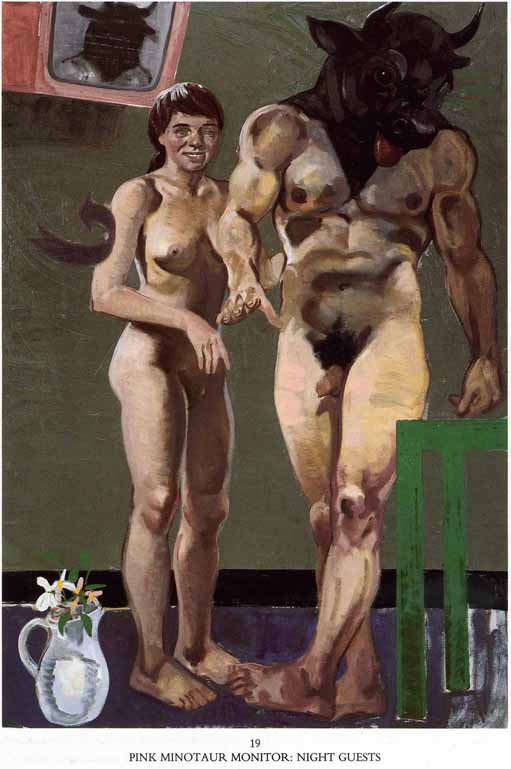
Pink Minotaur Monitor, Night Guests,
1982, Joe Shannon


But it was not the myths of the previous century that intrigued them, and nearly always, it was work predicated upon a strongly erotic theme. Picasso chose what he called "tribute" pieces such as The Intervention of the Sabine Women (after David) (above, left) dating from the early 1960s. Dali, on the other hand, seems to have embraced classical mythology almost by default in his vehement rejection of abstraction. But in both cases, these two giants of 20th century art were intent upon reinventing mythological painting to fit their own personal needs. Yet their influence can be seen in the work of artists such as the German, Max Beckmann, and the American, Joe Shannon. Beckmann's The Argonauts (below), dating from 1949 revives, for mythological purposes, the traditional Christian format of the triptych, which he later used for several religious works as well. His paintings, with their three separate compartments, seem very much within the narrative tradition of the Academicists, yet stylistically they relate much more closely to Picasso than to Beckmann's German forebears who invented the triptych. Shannon's Pink Minotaur Monitor, Night Guests (above, right), dating from 1982, draws upon the work of both Beckmann (stylistically) and Picasso (subjectively). From Beckmann he derives his rather heavy, idealized figures with their over sized feet and exaggerated physical attributes while borrowing from Picasso his fascination with the bull, which he displays both in "real life" and as seen in a painted TV image. His nude figures seem almost photographic, even pornographic.

The Argonauts, 1949-50, Max Beckmann
Early in his career, even the abstractionist's abstractionist, Jackson Pollock, delved into mythology, though hardly from a classical perspective, as he freely intermingled Native American, Pre-Columbian, and Greek themes. His Wooden Horse (bottom) of 1948 is an example. The drips, splatters, and highly gestural movement of paint on canvas that would later become his trademarks are present in this seminal work; but so too are attached items such as parts of a child's wooden horse which makes reference to the Trojan horse of Greek mythology. The common element Pollock and each of these other artists sought in their revival of painted mythology was not that of their academic predecessors. Unlike David, Ingres, Bouguereau, and others, they no longer needed mythology as a pretext for nude or erotic figures. Instead, they sought to adapt universally known mythological figures and themes to their existing style in such a manner as to add legitimacy--intellect, weight, and a literary element of respect--to their work. So, seen any good minotaurs lately?
 
The Wooden Horse: Number 10A, 1948, Jackson Pollock
--mythology where you would least expect it.
 

Thursday, November 1, 2012

Mythology II

The Abduction of Europa, 2007, Boris Olshansky--contemporary mythology
Compare this to the same subject in yesterday's blog as seen 100 years ago.
Yesterday (previous item) I wrote about the fact the mythology and religion, as viable subjects for the painter's arts, had declined to an alarming degree. A reader saw this as hardly alarming, perhaps even a positive development. Let me clarify. I think what I saw as "sad and frightening" about the virtual demise of mythological, and to a slightly lesser extent, religious painting, is the fact that as a result, painting has now become so narrowly focused. It's true, art historians have always had a need to categorize and conjugate past subject categories. It helps in the understanding of past art and artists. But, my point is that so many artists have now turned to depictions of their world, whether external or internal, literal or abstract, to such a degree that the vast majority have forgotten how to handle what used to be fully half their pool of art subject matter.


Undefeated, Steve Sawyer,
A macho Jesus?
By their very nature, mythology and religion demand story telling abilities, something that now seems to have been relegated to the art of cartoonists. There certainly are modern-day myths and religions as well, and I might point out I certainly never limited religious art to Christianity (I used the plural term, deities). Also, I'm not crazy about angels either. By the same token, I don't consider angels or "new age" art religious (contemporary mythology maybe). But mythology, as painted by our forebears, was never contemporary. I don't think the idea of contemporary mythology (as such) even occurred to them. Certainly it wasn't evidenced in their art. To place it in perspective, to some extent, ancient mythology was seen as an intellectual, perhaps light-hearted, but nonetheless socially acceptable cover for nudity with sexual overtones. It was also seen as a means of teaching great moral parables outside the context of religion, and at a time when religious art was starting its long decline from favor. Perhaps art today no longer wants to deal with morals and no longer worries about the social acceptability of nudity or sexual elements. If so, that too, would be sad and frightening.

Animal Man, 1990, Brian Bolland. The deterioration of narrative art--frightening
But moral considerations aside, speaking purely from an art point of view, I have to repeat; I think it's sad and a bit frightening that painters have let their narrative painting skills deteriorate to such an alarming degree, leaving it to TV, the movies, and cartoonists to carry on whatever may be left of this tradition. I dare say most artists I know, even the most experienced ones, would have a difficult time telling a religious or mythological story in paint. Most wouldn't even want to try. I've tried it and know from experience how hard it is. It's not something I'd want to do very often. It demands clarity of thought and purpose, exceptional organizational/compositional skills, and linear thinking beyond the scope of most working painters today. It's so much easier to just paint for the sake of painting, or to present a frozen, fully developed, conceptual conclusion in our work than to explain to the viewer visually how we arrived at that end.