Click on photos to enlarge.
Showing posts sorted by relevance for query colombia. Sort by date Show all posts

Friday, February 6, 2015

Santiago Martínez Delgado

Colombian Evolution, 1933, Santiago Martinez Delgado 
Santiago Martinez Delgado, 1940s
From what I've seen in studying the lives of great artist, now and then, typically they spend from three to ten years in academic study preparing their minds for the arduous tasks involved in the creation of their art. Now, add to that another eighteen years of general studies associated with growing to adulthood and you have twenty to thirty years. That's often fully one-fourth to one-third of the artist's life simply preparing to become an artist. In the case of a couple artist, which come to mind, that time equates to as much as half the artists' life. Raphael Sanzio da Urbino was born in 1483. He is said to have been fully trained by the time he turned eighteen. He died in 1520 at the age of thirty-seven. Nearly five-hundred years later (1906), there was born in Bogota, Colombia, a similar child prodigy, Santiago Martinez Delgado (Delgado being the mother's family name). He won his first major award in 1933 at the age of twenty-seven. He died in 1954 at the age of forty-eight. Raphael spent nearly half his life in training, Martinez well over half his life preparing to become an artist.
 
Bolivar and his Army, 1948, watercolor, Santiago Martinez
Interlude, 1941, Santiago Martinez,
the artist's mother and wife.
Actually, the two artists had more than that in common. Both had troubled childhoods, both were printmakers, both were painters, both painted murals, and both painted major historic figures from the past. Raphael painted Jesus, Mary, and (on rare occasions) Joseph. Martinez painted Simon Bolivar. Not to equate the two, but even Jesus and Bolivar had some things in common (but that's another matter). Santiago Martinez, grew up in during troubled political times in Colombia, his father being a Conservative Party leader implicated in a coup d'état and subsequently expelled from the country. (Raphael was orphaned at the age of eleven). Martinez began studying art at the age of eleven at the Bogota Fine Arts Academy. In 1926 he moved to Chicago to continue his studies at the Art Institute (he would have been twenty at the time). His first real art job was in making stained glass windows for no less than the famed Chicago architect, Frank Lloyd Wright, with whom he studied for another three years. In leaving Chicago to return home, Martinez walked away with the Logan Medal for the Arts awarded him for his mural, Colombian Evolution (top) at the 1933 Chicago International World Fair.
 
Rise of Jesus on the Cross, Cucuta Cathedral1945, Santiago Martinez
Don Quixote, 1947, Santiago Martinez
Back in Colombia, Martinez became the proverbial "big fish in a small pond" winning numerous private and government commissions. The Rockefeller family became one of his patrons. Painting in the popular Art Deco style of the time, Martinez won nearly as many awards as he did commissions. In 1945, he won the commission for the Cúcuta Cathedral stations (below), while simultaneously serving on various international art commissions, completing a series of prints on the life of the South American revolutionary leader, Simon Bolivar, becoming Colombia's leading art historian, and in his spare time, starting his own advertising agency in Bogota. He completed over one-hundred paintings in his lifetime (Raphael completed 102). Martinez's life suddenly came to an end on January 12, 1954 (from overworked, perhaps?) Raphael was also very much a workaholic, his death coming as a shock to the art world of Rome. He died on his birthday, April 6, 1520 (Good Friday).
 
Jesus Meets Mary, Cucuta Cathedral1945, Santiago Martinez
Illustration for the cover of Life
magazine,1940, Santiago Martinez.
Beyond all this, there is yet another interesting connection between the two artists. In 1938, Mrs. Maria Mendoza, a friend of Santiago Martinez, invited him to her home where she showed him a painting of the holy family, which she believed to be by the Colombian artist, Gregorio Vazquez Arce y Ceballos. Martinez, the leading art history expert in Colombia, took one look at the badly damaged painting and immediately informed her otherwise. He identified it as either a painting by Raphael Sanzio da Urbino, or one of his students. The painting, as was common at the time of its creation (before 1508) was painted on a wooden panel made of two blanks, glued together then covered with plaster (gesso). The two boards had separated right down through the middle of the Madonna's face. The two pieces had been bound together with wire. Of course recognizing a Raphael and proving a Raphael are two vastly different endeavors. Martinez took the painting, had it x-rayed, and showed it to a number of his Colombian colleagues, many of whom believed it to be a copy of a similar Raphael in Madrid's El Escorial. And in any case, if it was an authentic Raphael Madonna and Child (one of dozens), how the hell did it end up in Colombia? Fortunately, Mrs. Mendoza managed to answer that by supplying the all-important historic documentation (provenance). But for a final judgment, Martinez was forced to cart the fragile work off to the Met in New York where several Raphael experts looked it over, nodded in agreement, and named the work Raphael's Madonna of Bogota. From there, Martinez took his million-dollar discovery to Chicago where he turned it over to his old friends at the Art Institute to be restored. The results can be seen below. Where is the work now? No one seems to know; but the consensus seems to be that it's locked away in a bank vault for safe keeping...somewhere.
 
The Madonna of Bogota, before 1508, Raphael Sanzio da Urbino.
The painting as discovered is at left, the restored work at right.
(Those guys in Chicago really know their stuff.)


Friday, April 29, 2016

Panama Canal Art

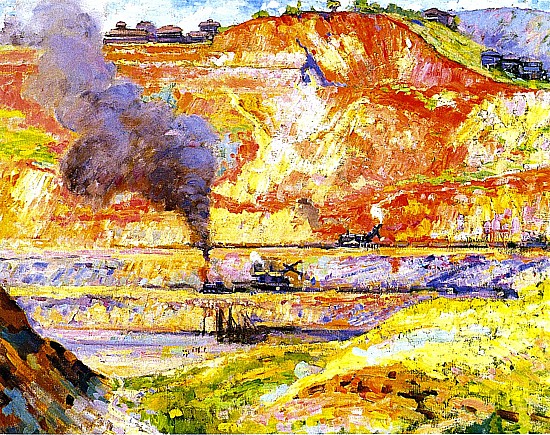
Panama Canal, Alson Skinner Clark
Yesterday, April 28, 2016, my wife and I passed through the Panama Canal aboard the MS Island Princess. The journey took some ten hours and covers about 48 miles as seen from our balcony on the Promenade Deck (below). It's a trip I've been planning for about ten years now, though it's been well down on my "bucket list" until recently. However, as I've checked off one "must-see" venue after another around the world, the canal has been steadily moving up the list. Then when my wife let it be known she did not wish to spend another vacation sitting in hotel rooms while I traipsed through a half-dozen major art museums, I suggested, a two-week cruise from Ft. Lauderdale to Los Angeles through the canal. She likes long, nothing-to-do-but-eat-and-relax cruises so, Panama it was.
 
Princess Cruise Line's Island Princess. Okay, so it's not the most
stunningly beautiful ship afloat, but it's better than a rowboat.
Launched in 2003, it was designed specifically for canal transit.
When one thinks of art, very likely some stunning, early 20th-century engineering marvel like this probably does not come to mind. Except for the Eiffel tower perhaps, most engineering marvels (especially from that period) are very often not particularly lovely--not that such beauty is as absolute necessity in terms of art content. It does help somewhat, though. As with most such works of man, the element of beauty depends entirely on how you look at them--your point of view--and not just the artist's viewing angle, location, and color selection, but also the viewer's frame of mind. The esthete would note that the Panama Canal is a far cry from the Taj Mahal, while the aforementioned Mr. Eiffel might cry, "WOW! What a gorgeous ditch."

The canal project as seen by the French, 1881.

Our friend Mr. Eiffel might also lament the fact that his own countrymen had been the first to attempt such a ditch--and failed miserably. Fresh off their success in digging the Suez Canal, the French moved on to bigger and better things, turning the first spade of Panamanian dirt in 1881. It quickly became apparent that a ditch across a desert was a far cry from the engineering trials and tribulations inherent in digging one's way (at sea level, no less) across the Central American Continental Divide (the Culebra Cut, top). As if that weren't challenge enough, then there were the damned mosquitoes. The worker mortality rate for Yellow Fever (and Malaria) was astounding--over two-hundred a month at one point. Worse still, the French didn't even know what was causing this devastating health problem. The French effort went bankrupt in 1889 after reportedly spending $287,000,000 and costing an estimated 22,000 lives to disease and accidents. It also wiped out the life's savings of roughly 800,000 French investors. The French asking price for a buyout was $100-million. Teddy Roosevelt negotiated them down to $40-million. A little "gunboat diplomacy" and another $10-million managed to free Panama from an uncooperative Colombia.


The politics of freeing Panama from Colombia may have been a bit shady, and billions of mosquitoes lost their lives in the process, but American engineering and the newly invented, but still crude, "steam shove," got the job done.
When U.S. President, Teddy Roosevelt (above), took over the project in 1904, he didn't start building locks and dams but in killing mosquitoes to keep them from killing American workers. Having conquered that foe, the key to the success of the Panama Canal was not in ditch digging so much as in dam building, specifically in harnessing the rough and tumble Chagres River which, during the rainy season (nine months out of the year) rises as much as thirty-five feet. The American solution was to create a massive, sprawling lake (Gatun Lake) some twenty-six meters (85 feet) above sea level (the largest dam and the largest manmade lake in the world at the time). This, of course, eliminating a hell of a lot of digging, not to mention supplying a reliable source of water flowing down hill on both sides to allow for gravity-fed system of huge locks, each 110 feet wide and 1,050 feet long. Moreover it was a two-way ditch.

If you build it, they will come...artists, that is...and tourists (above-top).
George Washington Goethals (left portrait) took over the building of the canal. Colonel David du Bose Gaillard (right portrait). U.S. Army Corps of Engineers, was in charge of the Pedro Miguel Locks and the Gatun Dam, as well as excavating the Culebra Cut.
The construction of the canal was completed in 1914, 401 years after Panama was first crossed by Vasco Núñez de Balboa. The United States spent almost $375,000,000 (roughly equivalent to $8,600,000,000 now) to finish the project. This was by far the largest American engineering project at the time. The canal was formally opened on August 15, 1914, with the passage of the cargo ship SS Ancon. Now, flash forward one-hundred years and we find a canal that, while still vital and viable, is, at the same time, hopelessly outdated. An expansion plan now nearing completion has two new flights of locks built parallel to, and operated in addition to, the old locks. Each flight ascends from sea level directly to the level of Gatun Lake. The new lock chambers feature sliding gates, doubled for safety, and are 427 m (1,400 feet) long, 55 m (180 feet) wide, and 18.3 m (60 feet) deep. This allows the transit of vessels with a beam of up to 49 m (160 feet), an overall length of up to 366 m (1,200 feet). As amazing as these numbers sound, some of the newest cruise ships being built today are already too large to pass through even the new and improved canal. Royal Caribbean's Oasis of the Seas, for instance, has a maximum width of 198 feet. The new locks are scheduled to open in June, 2016, little more than a month from now.

Present day watercolors by New Orleans artist, Al Sprague.
The shipping revolution that antiquated a canal.


Monday, September 16, 2013

Fernando Botero

 "Celebration" exhibit, Fernando Botero, 2012-13, Museo de Bellas Artes, Bilbao, Spain

Self-portrait with Flag,
Fernando Botero.
Writers and critics have to tread lightly when discussing the work of Fernando Botero. We have to choose our words carefully. Botero, by the way, is a Medellin, Colombian-born artist who seems quite intent upon living elsewhere, Paris at the moment, but also New York for several years, and an extensive list of other major art capitals around the world where he has worked and studied. Yet Botero calls himself the "most Colombian Colombian artist living today." Redundant, perhaps, but probably true; there simply aren't that many Colombian artists. Botero is a figural artist born in 1932. Having recently achieved the impressive age of eighty, he shows no sign of slowing down. Given current trends in political correctness, the reason writers have to be somewhat circumspect in discussing Botero and his work is that, without exception, his figures (often nude) are what could most politely be called "pleasingly plump." That's true even of his still-lifes, nice plump fruit.

 
Head of Christ, 2010,
Fernando Botero
La Giaconda, 1978,
Fernando Botero

Unlike those writing about him, Botero does not burden himself with volumetric niceties. He openly talks of his "fat" figures. Not since Hans Holbein painted Henry VIII have such figures graced art museum walls. Although it would be hard to imagine a Botero version of Henry VIII, Botero delights in creating his plump versions of the Mona Lisa, (above, left, which he titled, la Giaconda). There's also a Botero version of van Eyck's famous Arnolfini Wedding (with a very pregnant looking Mrs. Arnolfini), a quite hefty Louis XIV (ala Hyacinthe Rigaud), Adam and Eve, even Jesus Christ himself (above, right). By today's standards, none of these renderings could be considered flattering, nor, I suppose, are they meant to be. Botero makes no comments regarding today's "thin is in" standards of figural beauty, but then again, he doesn't need to. His work, most notably his sculptures (below) speak "volumes."

Liegende 1, 2010, St. Petersburg (FL), Fernando Botero. His sculptural figures are especially sensuous (nice tan). Renoir would have adored his work.

Abu Ghraib, 2005, Fernando Botero
Botero is not just about avoirdupois. He also paints current events, especially when they disturb him, as did the scandal involving the American-run Iraqi prison, Abu Ghraib (right). First exhibited in Europe during 2005, Botero did some 85 paintings accompanied by more than 100 drawings expressing his outrage--what he termed "painting out the poison." In 2007 this series was displayed at two U.S. museums. Botero refused to sell any of them, choosing instead to donated them to museums around the world. Botero has also weighed in on the drug violence in his own country with his bullet-ridden painting of Pablo Escobar, and similar images of his slain countrymen. Botero is often criticized, even hated for what is seen as his "making fun" of fat people. An overweight Mona Lisa is funny. A fat Jesus could be seen as sacrilegious. Tortured Arabs, even chubby ones, are not funny. Painted images of dead victims of Colombia's drug wars (bottom), even those responsible, regardless of their physical dimensions, are tragic.

Massacre, 2008, Fernando Botero


Sunday, January 26, 2014

Gonzalo Endara Crow

Lioviendo Companas (Raining Bells), 1987, Gonzalo Endara Crow

 
Gonzalo Endara Crow
When we Americans think and talk about Folk Art, we, in our provincial narrow-mindedness, tend to think only of American Folk Art of the Grandma Moses variety. The artsy among us, after a moment's thought, might bring to mind the work of French artist, Henri Rousseau. Of course, virtually every culture on earth has its own brand of folk art. Take the country of Ecuador, for instance. For those who were absent the day they taught South American geography, as the name suggest, simply look for the equator on the map then move your finger west to the Pacific Ocean and...BINGO...there you are. It's not a big place, once a part of neighboring Colombia to the north, and before that a colony of Spain (WAAY to the East for those really geographically challenged). Judging by the number of Ecuadoran street artists who imitate his style, Gonzalo Endara Crow is probably the most famous Ecuadoran artist in modern times. Which brings up something of a quandary: much of his work looks like that of a self-taught folk artist, but in fact, Endara Crow was University-trained.

El Tren Volador (The Flying Train), 1970s, Gonzalo Endara Crow
(one of several versions).
Gonzalo Endara Crow was born in Bucay, Ecuador, in 1936. He died in 1996. In his mid-thirties (1971), Endara Crow studied at Central University in Quito, his hometown, and incidentally, the capital of Ecuador (my own geography was deficient in that regard). His El Tren Volador (The Flying Train, above) painted around that time, is considered his best work, though he seems to have painted a dozen or so versions. However, in order to begin to know and understand Gonzalo Endara Crow, you also need to know something about Ecuador and Quito. As with most folk artists, this man and his art is a reflection of his background, his country, his era, and his culture. Endara Crow's father worked for the railroad, which would explain his son's fascination with trains. He also had a fascination with eggs, which completely escapes me, (and apparently others too).

Untitled, 1990, Gonzalo Endara Crow. Mt Pichincha, with flying train and apples or oranges. He apparently tired of painting colored eggs.
Ecuador, as mentioned earlier, lies right on the equator. That rings up images of dense jungle, dense heat, and dense humidity, right? That would be true except for the fact that Ecuador straddles the Andes. Endara Crow's home town of Quito is 9,225 feet above seal level. The average temperature, year round, is a steady 56 degrees Fahrenheit (13 degrees Celsius). The other important item you should know about Quito is visual--Mt. Pichincha. It is the second highest active volcano in the world, last erupting in 1999. It has its own glacier (on the equator, no less). That being the case, the greatest direct threat from a Mt. Pichincha eruption is not pyroclastic but a muddy flood. Mt. Pichincha hovers over the city of Quito (about five miles outside of town) much like an Ecuadoran Mt. Fuji (which it resembles). It hovers over Endara Crow's art as well. Yet, his Untitled (above) from 1990, which features both the mountain and his trademark flying train, is not the work of a typical folk artist...unless you count Surrealism as folk art. Some have called it Magic Realism. All of which seeks to put the artist in a box, complete with label and shipping instructions, ready for export north at least as far as Mexico, where his work is popular.

Monumental art by Gonzalo Endara Crow
The evidence seen in Endara Crow's lifetime work is that of a folk artist who outgrew the label. When does a folk artist cease being a folk artist and become something else? When he or she takes their first art class? When they enroll in an institute of higher education? When they begin to assimilate styles from outside their native culture? For several years during the 1970s, Endara crow taught at an art school. Does that remove him from the ranks of a folk artist. He also dabbled in sculpture, leaving behind his monumental "El Choclo" (corn, above, left) and "El Colibrí" (hummingbird, above, right) in the nearby community of Sangolqui. In America, folk artists have come to be called "Outsiders" in that their art is "outside" the mainstream. In Ecuador however, Endara Crow could hardly be considered an Outsider in that, having been deceased for more than fifteen years, any number of local artist have taken to imitating his style, colors, and content, making this difficult-to-label artist now mainstream...in Ecuador, at least.

Ecuadorian Dawn, Gonzalo Endara Crow.
From Folk Art to Surrealism to Abstract Expressionism in one lifetime.