Click on photos to enlarge.

Saturday, July 7, 2012

WPA Arts Projects

We're all familiar with the stereotypical image of the "starving artist". Some of us might even claim to have "been there, done that." Most of us, though, look far too "healthy" to make it stick. Though I'm sure the original image came from the West Bank or the Montmartre streets of Paris, our home-grown version no doubt came from the streets of New York. The image today is light-hearted and tongue-in-cheek, but starvation or even deprivation is no laughing matter. For the struggling artist, dedicated to his or her craft, life has never been a bowl of cherries, even in the best of times. But when times get bad for the nation as a whole, for those in the arts, living "on the edge" anyway, the situation becomes desperate. The phrase "starving artist" begins to describe not an amusing symbol, but a hopeless situation.

It would be hard to overstate the impact the WPA Arts
Project had on Depression era American artists.
This nation had already slogged through almost three years of downwardly spiralling economic depression before the Roosevelt administration came to power in 1933. By that time it was more than just an economic depression, but a social, political, and moral depression as well. Even those lucky enough to retain a job in such times still felt the pinch, struggling to make ends meet, going to bed every night wondering when or if the axe might next fall on them. For artists, from painters to playwrights, the axe had already fallen, often repeatedly, eliminating their livelihoods, depressing their spirits, often making it impossible to continue their art in any form. And pity the poor artist with a family to support as well. Fortunately, within weeks of his inauguration, like a white knight on a gallant steed, the Roosevelt Administration's new Works Project Administration (WPA) with it's Federal Arts Projects came riding to their rescue. To the liberal social activists of the era, it was seen as a godsend, a governmental revitalisation of the arts on a scale never before known in the history of mankind. To Roosevelt's political enemies, it was pure socialist propaganda.

The WPA playwrights at work.
Hard as it may be to understand, it was actually both. Whether liberal, socialist, or in some cases, Communist, the WPA artists were quite often political activists. Not so much in painting, but in graphic design, literary, and dramatic works such as the children's play, Revolt of the Beavers, their disgust for the status quo came thinly disguised. A critic called the play "Marxism a' la Mother Goose". But even in the presumably benign art of post office mural painting, controversy was only just beneath the surface as in the case of Fletcher Martin's Mine Rescue (above), a Social Realism design for the post office in Kellogg, Idaho. It was to depict an injured miner being carried on a stretcher to safety. Local citizens objected, fearing the subject might pain those who had lost a loved one in one of many mine accidents in the area. At first the government defended Martin's design, but later settled on an inoffensive "compromise" entitled Discovery, depicting two excited prospectors discovering a local lode of precious metal.
Mine Rescue, 1939, Fletcher Martin
Thus whether it was Social Realist painting, disheartening photos of the nation's poorest poor, posters designed to raise morale, songs written to do the same, or dance companies and drama troupes seeking to unveil the worst social injustices of the time, the Federal Arts Projects were more often than not political. Today we would call it political public relations, emphasising the bad, promoting efforts at improvement, and trumpeting successes. It was not a program aimed at turning out masterpieces, though, given the high quality of creative talent employed, this was sometimes the case. Instead it was an effort to literally save an entire generation of artists. And from Thomas Hart Benton to Eric Sloan, to Ben Shahn, to Hans Hofmann, and photographer Dorothea Lange, it did just that. In the area of photography especially, many of the WPA's images have burned their way into our national psyche.

Noble County, Ohio, 1938, Robert Lepper
Never intended as a permanent institution, the program came to an end in 1943 as the nation came to grips with its more urgent wartime concerns. But far away from the hard-bitten streets of New York City, in unheard-of places like Nappanee, Indiana, and Caldwell, Ohio, the WPA artists left behind a legacy of exceptional images which have stirred the pride and stimulated the minds of generations since. No one got rich off this art, least of all the artists themselves; but no one starved creating it either. And this country, and those inhabiting it now, as then, copped one of the greatest art bargains since Julius II decided his chapel ceiling needed a fresh coat of paint.
Waiting for the Mail, 1937, Grant Wright Christian, Nappanee, Indiana, post office.

Friday, July 6, 2012

Art Brut

Irren-Anstalt Band-Hain, 1910,
Adolf Wolifi, one of the earliest
examples of Art Brut
Ever hear of "Art Brut?" Chances are, especially if you have children, that you may have some. If they're young, it's probably on the refrigerator door. If not, check the old trunk in the attic where you keep their school report cards and scrapbooks. If you have no children, you may have some of your own Art Brut, especially if you have "pack rat" tendencies. What is "Art Brut?" Translated it means raw art. French artist Jean Dubuffet called it, "Art (that) doesn't lie down in the beds you make for it." If you collect weird things, rocks, seashells, dead flowers, funny shaped potato chips, or if you make weird things - wood carvings, indecipherable drawings and paintings - or even write weird things, music, poetry, especially if it's accompanied by illustrations, chances are you're into art brut. Perhaps it's easier to define by its limitations - art without training.
Jean Dubuffet Self-portrait, 1966


Though he had some early training in art, no one knew more about art brut than Jean Dubuffet. Though technically a Post-WW II painter, Dubuffet often used paint more like glue, merely as a colourful binder to incorporate just about anything else into his paintings. If it could be ground up and mixed with paint, it was fair game. Dubuffet became enthralled with the art of young children and attempted to carry this innocence into his own work. And he began to collect such things, primarily the work of the insane and mentally disturbed. When he died in 1984, he left a sizable collection of his own work, and that of others which he'd amassed, to the Swiss city of Lausanne where he'd spent much of his youth. Even before his death, in 1975, in an 18th century chateau he owned there, Dubuffet opened his Collection de l'Art Brut, a sort of "anti-museum" to display some 5,000 pieces of such work. Today, the museum has about 30,000 pieces, of which only about 800 can be displayed at one time (a plight apparently shared by anti-museums as well as those of the regular sort).

le Théâtre de l'univers,  ca. 1936, Aloise Corbaz,
So, what might you find on the dark, blackened walls of an "anti-museum?" How about stones collected by an Austrian prince which resemble animals or figures. He believed they were prehistoric sculptures. Or the work of Aloise Corbaz, a former governess at the court of Germany's Kaiser Willhelm II. Her brightly coloured drawings were her only communicative outlet as she did all the ironing at an asylum to which she'd been committed for her "extreme pacifism." Then there's the collection of people and animal figures once belonging to a telephone operator (thought by her to have magical powers). There's also the amazing, colourful costumes sewn together by an American drifter from scraps of cloth he begged for on the street. You'll find figurines made of bread crumbs and unbaked clay dipped in glue - a whole orchestra of them in fact. The anti-museum even has an entire wall of intricately carved wood from a French asylum, hewed with a broken spoon by a French shepherd confined for trying to set fire to his family home with burning bank notes.

The Realms of the Unreal, 1973, Henry Darger
One of the anti-museum's most amazing works is a 15-volume manuscript with hundreds of illustrations, some more than ten feet wide, detailing the adventures of seven sisters in a bloody war of liberation against the Landelinians, a fictional group of villains who enslaved children. The watercolour paintings and their accompanying manuscript, The Realms of the Unreal, were the work of Henry J. Darger, a Chicago hermit and part-time hospital custodian, who died in 1973. His landlord found them and donated them to the museum. About the same time, a Swiss psychiatric patient wrote music, not words, accompanying himself with similar fanciful drawings of exquisite detail and beauty. It was music no one as yet been able to decipher. For all its varied forms, art brut is art from the frontiers of mental excursion. It is art in revolt. Some of it is art only by the broadest definition of the term. All of it is art in its purest, rawest, unrefined form - art which operates within its own realm of creative expression.

Thursday, July 5, 2012

Andrew Wyeth

Andrew Wyeth Self-portrait, 1945
He was born in 1917, the was the son of a internationally famous illustrator. All but two of N.C. Wyeth's children became artists. One became an engineer, the other a musician. All studied painting with their father from the time they were able to hold a brush. Andrew, the youngest, was home tutored from childhood. He became the most famous of the Chadds Ford clan, with success coming at a very young age. He had his first one-man show in New York City in 1937 at the age of 20. His palette was sombre and still is--greys and browns predominate. His medium of choice was watercolour and tempera though he also sometimes works in oils. His style is as sombre as his palette. Some find it cold. Others consider it as dry as the drybrush painting technique he often uses. Many find his austere realism disquieting. Despite this, for years he has been one of my two favorite artists.

Christina's World, 1948, Andrew Wyeth
Wyeth's work centered on two locales, the Brandywine Valley of south-eastern Pennsylvania and the coast of Maine where he spent much of his childhood, and where today, his son, Jamie, lives in a restored lighthouse. Andrew Wyeth first came to notice in the art world with the purchase by the Museum of Modern Art of his 1948 painting of Christina Olson (Christina's World), the crippled daughter of one of his Port Clyde neighbours. Christina died in 1968 and the Olson home, depicted in the painting is now listed to the National Register of Historic Places (the first ever to be so listed because of a painting). Christina and her brother appeared in numerous Wyeth paintings. More recently his relationship with Helga Testorf (below), a Chadds Ford neighbour and his intensely sensitive nude portraits of her have shed new light on both the man and the artist.


Braids, 1979, Andrew Wyeth,
portrait of Helga Testorf, his frequent
 model and mistress.
Accolades over the years have come almost by the bushel. Both President Eisenhower and former Soviet Premier, Nikita Khruschev, greatly admired his work (though different works). He was the first painter to ever receive the Presidential Freedom Award, given by President Kennedy in 1963; and in 1970, became the first living artist to ever have a show at the White House. He's also the only American painter besides John Singer Sargent to ever be elected to the French Académie des Beaux-Arts. The following year, 1978, he was made an honorary member of the Soviet Academy of the Arts. And in 1980, the British made him the first living American artists to be elected to the Royal Academy. At home, his work routinely broke attendance records at museums wherever it is shown. In 2007, he received from President Bush the National Medal of Arts. He died January 16, 2009 at the age of 91.

Wednesday, July 4, 2012

Jack Levine

Jack Levine
We all read the newspaper, maybe not daily, but often enough to usually be aware of what's going on in our local communities if not in the world at large. Sometimes we get a little roiled up about what we read and spout off to our spouses regarding some outrage in our minds. A few of us may even rise to writing letters to the editor. And, having done so, our rancorous rage at least temporarily vented, we settle back in our Lane recliners and let it go at that. No, I don't own stock in the company.) I wonder though, how many of us have ever picked up brushes and painted our outrage? I never have. But then, I've never written a letter to the editor so I guess I've never been mad enough. At any rate, when we begin to talk about this type of outraged, artistic behavior, aside from some very talented political cartoonists up and mucking about at the moment, the name of only one painter comes to mind--Jack Levine.

Feast of Pure Reason, 1937, Jack Levine
Jack was born in 1915, a Jew, in the rough and tumble, bare-knuckles precincts of South Boston and Roxbury, Massachusetts. He studied art at the Museum of Fine Arts in Boston. One of his first works, The Feast of Pure Reason grew out of his memories of the crime, corruption, and immorality rampant in the streets of his boyhood bailiwick. In New York, he quickly became a part of the Social Realist Movement. With the start of WW II, he quickly became a part of the US Army. When he returned, he found the art world of SOHO and Greenwich Village awash in the abstract splatters of the New York School. Though his style had always had much of the loose, painterly qualities of the so-called "action painters," the Abstract Expressionist ridiculed his work. In 1946, he met their criticism head-on with a painting titled Welcome Home, a work dripping not with paint, but sharp irony and brutal jabs at the government as well as the art establishment of the time. And while it didn't exactly endear him to the powers that be, it did secure him a place of respect in the same art community he so often satirized in his paintings.

Welcome Home, 1946, Jack Levine
As the forties melted into the fifties and sixties, Jack took on mobsters, corporate presidents, movie moguls, and stuffed-shirt, banana republic generalissimo. His immortal Gangster's Funeral, from 1953, is a perfect example. Any resemblance to persons living or dead is purely intentional. At first glance, the painting would seem to be in step with the Abstract Expressionism, but closer study reveals much more the influence of the old masters, from the Mannerists, right up through the Baroque, and Picasso, with brief adieus to Rembrandt and the Flemish painters. His later work, up until his death in 2010 at the age of 95, aimed pointed barbs poking at crooked cops and crookeder politicians. Levine also paid homage to Titian and Rubens as he satirized classical myths and even Old Testament figures from a unique, Jewish point of view. So, the next time Congress, the Pentagon, or Barack Obama does something that ticks you off, don't write to the editor, unleash your brushes, draw their picture, and squirt some paint in their faces.

Gangster's Funeral, 1953, Jack Levine

Tuesday, July 3, 2012

George Luks

George Luks, by Robert Henri
Did you ever know anyone with such a natural drawing and painting ability that every move they made looked good? As artists, all of us probably have better than usual eye-hand coordination, but there are always a few with so much of it that everything they do looks completely effortless. While most of us labor at our work (which all too often looks labored when finished) these people whip out a few strokes, daub on a little color, seem to be having the time of their life, and finish with a masterpiece every time with about the same lavish movements one might expect in painting the side of a barn (a real barn, not a painting of a barn). Don't ya just hate people like that? Often of course, such carefree, effortless renderings are the results of long, hard nights and days of study and practice. But there are a few rare birds out there where this is not the case. In fact, one of them is fondly remembered as boasting, "I'm George Luks and I'm a rare bird! You people stick with me and you'll have a good time."

The Cafe Francis, 1906, George Luks 
George was rare all right. He had a grand total of about four weeks of art school in his whole life, one month when he decided to attend classes at the Pennsylvania Academy of Fine Arts in 1884. That was it, although he often was in the habit of hopping a boat to Europe on the spur of the moment where he seems to have enjoyed the nightlife as much as the museums. There too, however, he enjoyed Frans Hals, proclaiming, "There are only two great artists in the world--Frans Hals and little old George Luks!" He had that right. His work is so often compared to that of Hals even he probably grew tired of it. However in the 1906 painting, The Cafe Francis, we see not Hals, but much more the influence of Renoir, and his fellow Ashcan illustrator and friend, William Glackens' Chez Mouquin painted the year before. It's even the same gentleman in both paintings, the boisterous New York playboy, James Moore with one of his so-called "daughters."

Pals, 1907, George Luks
Of course we know Luks far more for his dark palette and his Frans Hals portraits of very common street people such as his 1907 Pals depicting what we could call today a "bag lady" and her colorful macaw. Here is Luks at his best, so much like Hals and his famous Malle Babbe (1630) portrait of a robust bar "maid" with her coffeepot-size tankard and pet owl on her shoulder, as to easily be a companion piece. Despite his lack of formal training, Luks worked as an illustrator for the Philadelphia Bulletin, and even sometimes as a cartoonist, both of which traits can easily be seen in his work. A cohort of "Ashcanners" Robert Henri, John Sloan, Everett Shinn, and Glackens, he followed them from Philadelphia to New York where he established his painting career, exhibiting with them under the infamous label, "The Group of Eight," as they fought the same academic dominance as had the French Impressionists some twenty-five years before. A participant in the equally infamous Armory Show of 1913, he later won prestigious awards from the Corcoran Gallery of Art and the same Pennsylvania Academy where he'd ever-so-briefly attended classes. In addition to his art, Luks' drinking and brawling made him something of a legendary figure in that sense too. He's said to have died in the doorway of a New York bar, at the age of 67, having grown much too old for such a lifestyle. The press reported he had a heart attack while waiting to paint "the dawn's early light" in the city streets.

George Luks the cartoonist, 1899.

Monday, July 2, 2012

Frederic Edwin Church

Heart of the Andes, 1859, Frederic Edwin Church 
We've all done it, especially those who grew up in or near cities; stood in a line, often stretching around the block, slowly moving closer and closer to the window where we paid our twenty-five cents and then went inside to see an afternoon matinee. The year was 1859. A similar line stretched out for more than a block. In just three weeks, twelve thousand people paid their quarters to see a picture...not a moving picture, but a painting. As movie screens go, it wasn't very big. But for a painting, it's six-foot by ten-foot dimensions were adequately impressive. The place was New York City, the studio of Frederic Edwin Church. The painting was titled Heart of the Andes. As a movie critic might intone, it was exotic, expansive, exciting, beautiful to look at and breathtaking to contemplate. Though not "shot" on location, nor even depicting an actual scene, Church had been there and done that, his work based upon hundreds of sketches made on location over a period of almost a year trekking up and down the mountains of Ecuador with his friend and fellow landscape painter, Charles Remy Mignot.

West Rock, New Haven, 1849, Frederic Edwin Church
Church was kind of the painting equivalent of Cecil B. DeMille. He was an expert draftsman, a brilliantly accomplished painter, a stickler for details, an expert naturalist, a world traveler, a consummate showman, and probably the first artist in American history to become a millionaire. His Persian style mansion on a hill towering one-hundred feet over the Hudson River not only bears witness to his nineteenth century taste in architecture and landscaping, but also his prodigious painting accomplishments during his lifetime. Church was born in 1826 into a wealthy Hartford, Connecticut, family. His artistic pedigree springs from an apprenticeship to none other than the painting icon of the Hudson River School, Thomas Cole himself. With Cole's death in 1849, Church became the unquestioned leader of this famed "institution." But Church's name had bigger things written on it. Based solely on the strength of a single painting, West Rock, New Haven, Church became the youngest member ever to be elected to the prestigious National Academy of Design. He was 23.


The Andes of Ecuador, 1855, Frederic Edwin Church

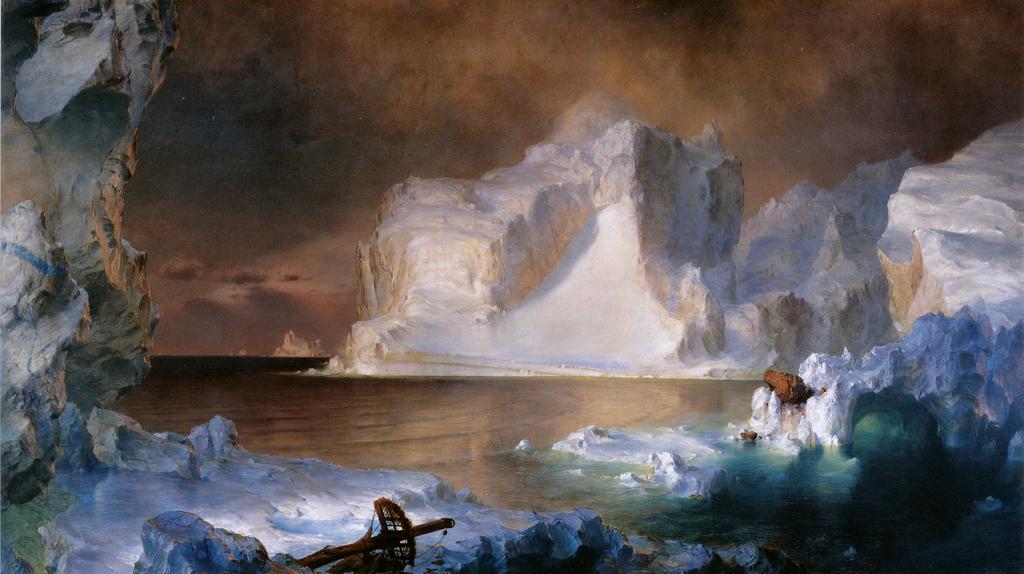
West Rock, New Haven sold to Cyrus W. Field of transatlantic cable fame. The two became close friends as Field often accompanied Church on drawing excursions into the New England countryside. In 1853, Church took Field with him on his first trip to South America. The painting, The Andes of Ecuador was the result of that little expedition. At a mere four-foot by six-foot, it's somewhat smaller than his blockbuster hit a few years later, but still big enough and strong enough to establish his reputation as the most important landscape painter in America. Both paintings were full of conceptual analogies involving the harmony of nature, man, and God based upon the theories extolled by English art critic John Ruskin and the German scientist/philosopher, Alexander von Humboldt.  However, these concepts were confounded in 1859 by the publication of Darwin's Origin of the Species, which proposed the theory that nature was based, not on harmonies, upon competition and struggle; disputing the assumption that nature offered any kind of model for man's moral guidance. Church died in 1900, somewhat disillusioned perhaps, that his art and his "landscape philosophy" were no longer in style.  Yet today, his grandiose visions of exotic earthly beauty still loom large--landscape painting so magnificent as to be more accurately deemed, "earthscapes."
The Icebergs, 1861, Frederic Edwin Church,
exquisite color combined with seldom painted
subject matter.

Sunday, July 1, 2012

Asher B. Durand

Asher B. Durand Self-portrait, 1835
It's not uncommon for working artists to have a "day job." Being an artist therefore creates the equivalent of working two jobs. One, of course, puts food on the table, the other puts satisfaction in the heart.  One allows the artist a home life, the other eats it up. At one he or she earns a living, while the other sometimes may actually be something of a costly hobby. Lucky is the individual who has a day job that is art related, allowing him to avoid the virtual split-personality which is often the case when the artist's real world and his art world tend to compete for his time and affections. Every artist in this situation hopes that one day, their art will lift from them the burden this dual existence and allow them to concentrate on that which they loves best. It happens. The dream does sometimes come true. It happened that way for the early American artists, Asher Brown Durand.

 Engraving of John Trumbull's Declaration of Independence, 1823, Asher B. Durand
Born in 1796, Durand apprenticed to an engraver. All during the 1820s and 30s he worked long and hard at his trade, enjoying great success to the point that by the time he was thirty, he was the top engraver in the entire country, rendering etched printing plates for everything from business letterheads, stocks, and bonds, to commercial bank notes. On the side, he began painting portraits of his wealthy commercial clients. Living and working in New York City, he met Thomas Cole, then the preeminent landscape painter in the country. Cole encouraged him to try landscapes and often took him along to the country where they painted together. By the 1940s, Durand had switched from portraits to landscapes rendering scenes up and down the Hudson River, later venturing into the Catskill, Adirondack, and White Mountains which made up the New York state geography.  Engraving had been work. This was a labor of love. Following the dream of most truly dedicated artists, he eventually gave up his day job.

Kindred Spirits, 1849, Asher B. Durand
Although he assumed the mantle as the leader of what's since been deemed the Hudson River School, Durand was no plein air painter or slave to nature. His works were always done in his studio, usually during the winter months based upon detailed drawings he'd done on location during the summer.  Already well-to-do, paintings such as his 1849 Kindred Spirits made him wealthy. In Europe, it was the Romantic era, and that was the case also in this country, at least insofar as the American landscape was concerned. Clients would often commission landscapes, describing what they wanted to see, often including sentimental details, from which Durand would create nostalgic, somewhat idealized woodland settings based on his own designs, often following formulas of his own invention or copied from the great landscape painters of Europe. So broad was his experience and travels that he could often render actual locations from memory. Durand died in 1886 at the age of ninety, long after the tranquil, bucolic, Hudson River settings he'd painted as a young man had ceased to exist under the relentless march of civilization. He never once regretted giving up his "day job."
Study from Nature: Stratton Notch, Vermont, 1853, Asher B. Durand,
one of his more unusual works.