Click on photos to enlarge.

Tuesday, May 6, 2014

Art and Jesus--The Crucifixion

The Crucifixion, ca. 1300, Giotto

Crucifix, ca. 1200, Master Guglielmo
Undoubtedly, the most powerful image from the life of Jesus Christ is that of his crucifixion. Yet strangely, artists were fairly late picking up on the death of Christ, despite it's crucial importance in Christian doctrine. In fact the earliest graphic depiction of the crucifixion was in the form of anti-Christian graffiti (below, right). It wasn't until around the year 1200 that artists such as Guglielmo began to explore Christ crucified as in his crudely painted crucifix from that period (left).


The Alexamenos Graffito, 2/3rd c.
CE, tracing of the drawing
The Medieval artist Giotto, around 1300 (top), was one of the earliest to evoke the pathos of this theretofore unspeakable act of torture in fresco (painting on wet plaster). Though highly decorated, with angels swarming like gnats, the saints, donors., and royalty at the bottom add a certain contemporary poignancy to the scene. His Crucifix of Maria Novella in Florence (below, left), is closely related to the fresco.
 

Crucifix of Santa Maria Novella,
1290-1300, Giotto di Bondone
Holy Trinity, 1425, Masaccio
Masaccio's Holy Trinity fresco (right) dating from 1425, while depicting the crucifixion, goes beyond that to explore the relationship of God the Father, Christ the Son, and the Holy Spirit to Christian worshippers (depicted at the bottom).
 
Crucifixion, 1455-60, Andrea Mantegna
Christ on the Cross, 1541, Michelangelo
A generation later, around 1455-60, the Italian artist, Andrea Mantegna (above), was one of the first to paint the crucifixion in oil in this rather garishly colored altarpiece. About a hundred years later in 1541, the great Michelangelo tried his hand at depicting Christ on the Cross (left). The head seems too small.


Crucifixion with Centurion, 1538, 
Lucas Cranach (the elder).
By the 16th century the crucifixion had become a standard item in most artists' repertoire, though it remained a difficult subject to embrace. Some artists were not as successful as others, as seen in the work of Lucas Cranach (the elder), and his ineptly rendered, totally unscriptural Crucifixion with Centurion (left), which adds an almost comic element to the scene.

Isenheim Altarpiece Crucifixion, 1510-15, Mathias Grunewald
By the same token, the German artist, Matthias Grunewald moves to the opposite extreme in his excruciatingly detailed, melodramatic image. The work is the central panel of the famous Isenheim altarpiece (above) from around 1512. His style is typical of northern Renaissance artists.

Crucifixion, 1622, Anthony van Dyck
Christ on the Cross with the two
Marys and St. John, El Greco
The Baroque artist Anthony van Dyck (above, left), painting in 1622, was among the first to give us the naturalistic image of Christ's death, to which we've become much more accustomed. Yet, at about the same time, the Spanish artist, El Greco (above right), renders a much more spiritual, more stylized depiction.

The Crucifixion of Christ, Tintoretto
 
The Crucifixion, 1632,
Diego Velasquez
We've looked at the work of the Mannerist painter, Tintoretto, earlier and here we see that his Crucifixion (above), though perhaps quite accurate, is every bit as darkly dramatic as his Last Supper. Mary and John are seen at the far left. What appears to be an entire Roman legion fills the background.

The Spanish artist, Diego Velasquez moves to the opposite extreme in his straight-forward, highly simplified, 1632 depiction of The Crucifixion (left). Rembrandt, on the other hand, though also Dutch, is much more subdued in his handling of the very same subject (below, left). The figure in the background wearing a turban is Rembrandt himself, who, because of his sins, is symbolically taking responsibility for Christ's death. Far more Baroque, the Dutch artist, Peter Paul Rubens overwhelms us with brute force in his muscular Raising of the Cross (below, right), also dating from the early 1600s.


Crucifixion, 1633, Rembrandt, includes
a self-portrait in the background.
Raising of the Cross (center panel),
1610-11, Peter Paul Rubens

Flagellation, 1880, Bouguereau,
Active violence was more "Romantic."
Sketch of Christ on the Cross,
1845, Delacroix.
Pieta, 1876, Gustave Moreau
During the 1700s, religious painting, and thus crucifixions, took a rest. The subject was hardly suited to the frivolous, light-hearted Rococo style of this era. But with the advent of the Classical style in the early 1800s, we find French artists such as Bouguereau not only returning to the subject but depicting the crucifixion in brutal, almost photographic detail. His Flagellation (above, left) from 1880, is not actually a crucifixion but an even more actively violent depiction of an event occurring hours earlier. By mid-century, with the coming of the Romantic era, the French artist Eugene Delacroix gives us a much more heartfelt oil sketch, seemingly done at the foot of the cross during the event itself (above, right). Gustave Moreau's Pieta (left, Mary with the body of Christ) also from the Romantic era around 1876, though not a crucifixion, is much in the same vein.

White Crucifixion, 1938, Marc Chagall
The 20th century brought us Modern Art. The crucifixion was hardly a mainstay of this era but it's not without highly individual renderings such as Russian artist, Marc Chagall's White Crucifixion (above) dating from 1938. He depicts Jesus against a background of anti-Semite violence. Interestingly, Chagall was Jewish.

Crucifixion, 1954, Salvador Dali
Christ of St. John on the Cross,
 1951, Salvador Dali


During the 1950s, the Spanish surrealist artist, Salvador Dali took the crucifixion and made it his own as seen in his Crucifixion, (above, left) from 1954 as seen in his own brand of exquisitely rendered, strangely supernatural Surrealism. Perhaps his most powerful piece, Christ of St. John on the Cross (above, right), gives us a "God's eye" view of Christ's suffering. Whether with paint on canvas or on paper, Dali explored the crucifixion  like no other artist before or since. From the same point of view, the famous Riker's Island Crucifixion (below), was donated by the artist in 1965 after he had to cancel a lecture and demonstration there. For many years, it was displayed in the New York City prison.

Riker's Island Crucifixion, 1965, Salvador Dali


Monday, May 5, 2014

Art Frahm

Tourists, Art Frahm

1950s glamorous beauties
By the time you're reading this, my wife and I may be sitting exhausted on a street curb in San Francisco not unlike Art Frahm's colorful friends above. We may be out of our minds, but we've chosen this year to take a cross-country driving tour, visiting our son and his family in Phoenix, then taking the "long way" back home to Ohio via L.A., San Francisco, maybe even Seattle. I don't know, but I'm guessing the American illustrator, Art Frahm, was far too busy (or had better sense) than to embark on such an exhausting excursion.

Often I chafe at those making any great distinction between artists (painters) and illustrators, but in Art's case, I'll tolerate any discussion of disparity. Art Frahm was no academic; had little or no formal training in art other than working as an assistant for Haddon Sundblom (the Coca-Cola Santa Claus artist); and often his technical skills were barely adequate for the job at hand.

Beautiful, glamorous, sexy, white ladies, usually not so well attired.
Frahm painted so many variations of
this scene he literally wore it out.
The San Francisco hobos (top) were not typical Art Frahm art, though he did paint the surprisingly well-dressed group on several occasions as they popped up here and there on their rail journey around the country. Frahm painted beautiful ladies...beautiful, glamorous, white ladies, beautiful, glamorous, sexy "ladies," frequently in stressful situations. Often such situations had their root cause in cheap elastic (as in around the top of their undergarments, if you get my drift).

Someone (maybe me) once said that if Norman Rockwell had been a pervert, he would have faced stiff competition from Frahm. Frahm's specialty was pin-up calendar "art" (the quotation marks are an outright necessity is this case). Though I was never aware of the artist's name, I can remember seeing his work on such calendars. Usually they hung on the wall of grimy auto repair establishments, during the 1950s and 60s as I was a growing boy having a certain fascination with such profound depictions of feminine beauty. Frahm was one of a "talented" group of maybe a half-dozen other such American illustrators producing a steady, monthly supply of such enticing beauty. Though not necessarily among the best, Frahm's sense of humor often made up for his lack of technical proficiency.

Safety Wins, 1961, Art Frahm
Slip Tease, Art Frahm
Of course, Frahm's female depictions were not limited to distressed ladies discreetly concealing their ankles from public view. Pinup calendar publishers were also fond of scantily (though discreetly) clad bathing beauties on the beach (bottom, left) as well as the ever-popular, demurely-posed nude figure (right), though Frahm painted surprisingly few of the latter. While the high-brow esthetes of New York's SoHo were starving themselves trying to make names for themselves by abstractly expressing themselves, Frahm was doing quite well, thank you, with his (more or less) naked ladies. Yet Frahm's figures, while possibly in poor taste at times, never descended to a level of explicitly lewd graphic sex. Moreover, one of the more fascinating aspects of Frahm's loosely defined art is the fact that the same artist who painted the "distressed' pet owner in Slip Tease (above, right) also came up with the downright wholesome parade of adolescent school children seen in Safety Wins (above). Frahm may not have been the best or most versatile artist/illustrator to ever cash in on risqué monthly depictions, but he was certainly not stuck in a rut.

Not Rockwell, but not
typical Frahm either.
You can't beat the combination
of sex and patriotism
Rose, 1940s, Art Frahm (no Rosie the Riveter).
Art Frahm was born in 1907, and grew up in Chicago. He died in 1981. A few years ago his work would have been decried as "sexist." Today, it's little more than dated, somewhat amusing evidence of the continuing social changes we see daily and our level of moral outrage regarding nudity, sex, and more specifically, the female anatomy. What would have been deemed little short of obscene, even pornographic during the 1940s, 50s, and 60s when Frahm was so prolifically producing such pictures, today, while not likely to turn up on a calendar in a church basement, hardly raise an eyebrow, and certainly falls far short of present-day erotica. Unfortunately, porn just ain't what it used to be.

Puppy Bath, 1940s, Art Frahm.
Even when painting little girls, the artist loved short skirts and bare legs.


Sunday, May 4, 2014

Mariano Fortuny

Mariano Fortuny's massive battlefield masterpiece,
National Museum of Art of Catalonia, in Barcelona, Spain.
Virtually every painter likes to be rewarded with commissions. It validates our past work, confirms confidence in future creations, and best of all, lines our pockets. Sometimes a big commission will push the artist well out of his or her "safety" zone, resulting in exceptional works of lasting artistic value far beyond even the artist would have thought possible. But, how would you like to be rewarded with a commission which begins with the purchase of fifteen yards of canvas? The painting would eventually measure a mere thirty-one feet wide and just short of ten feet in height. Today, the it hangs in the National Museum of Art of Catalonia, in Barcelona, Spain, where it sports a brand new frame, the largest ever built for the museum. On that scale, the painting, though on canvas, begins to move into the realm of a mural, and in fact, flirts with the term, diorama.

Mariano Fortuny Self-portrait, ca. 1860
Needless to say, being awarded such a huge commission was the chance of a lifetime for the twenty-two-year-old Spanish painter named Mariano Fortuny. One can't help but think though, that as exciting, challenging, and rewarding as such a commission must have been, it must have also been more than a little intimidating as well. Yet Fortuny was no stranger to large-scale academic works, having shortly before completed a painting for the Royal Gallery of Versailles titled Godfrey de Bouillon proclaimed King of Jerusalem. In fact, his very first painting, done when he was a child of eleven, a resurrection of Christ, had been purchased by Queen Christina of Sweden. This painting, commissioned by the Catalonia government was to be a battle scene depicting the Spanish victory over Moroccan forces in the Battle of Tetuan during the Spanish-Moroccan War of 1859-60.

Mariano Fortuny, hard at work on a preparatory drawing for his "big painting."
The blood was hardly dry on the battlefield before the ambitious young artist was off to Morocco to get a feel for the place and begin sketching resource material. Fortuny attacked the project much like a modern-day movie director might do in preparing for a film. For the better part of three months, Fortuny travel about the desert country, living in a tent, writing almost daily in keeping his governmental clients abreast of his work and that of an entourage of several aides and apprentices. They drew the natives, painted preliminary color sketches while all the time soaking up the exotic "color" of the land (and the erotic culture), as well as collecting "souvenirs," uniforms, weapons, and reports of battlefield tactics. Battlefield scenes were a big item in the art world. They demanded immense scale, dramatic action, and in some cases, an extreme obsession with accuracy. For all his seemingly overwrought attention to detail, the man knew what he was doing. Besides, the government was paying the bills. For his efforts, Fortuny was to be paid 40,000 escudo for the painting plus a per-diem of 2,000 escudo per month for his time in Morocco. (I've not been able to trace down a modern-day dollar equivalent for any of that.)


Capturing camp Abd-El-Kader in Tagin, Algeria. May 16, 1843,
painted in 1844, Horace Vernet
Capturing camp Abd-El-Kader in Tagin, Algeria.
May 16, 1843 (detail), Horace Vernet.
In 1860, Fortuny returned to Spain, intent upon setting up a studio in Rome, where he planned to paint his massive masterpiece. The city fathers in Barcelona though it wise to send their budding young artist off to Paris to be inspired by the work of French artist, Horace Vernet, whom one might term the "battlefield artist to end all battlefield artists." If Fortuny's canvas was huge, Vernet's 1844 Capturing Camp Abd-El-Kader in Tagin, Algeria. May 16, 1843 (above), was nothing short of enormous--23 yards long--which, indeed, puts it into the diorama category. Fortuny was impressed, to say the least. Overwhelmed, might be a better word. Rather than being inspired, he was demoralized. If a Vernet battlefield was what his Catalonia elders were expecting, it began to dawn on the young painter that he was in over his head...WAAY over his head.

The Odalisque, 1861, Mariano Fortuny--lots more fun than painting battlefields.
The Tapestry Merchant (detail), 1870,
Mariano Fortuny
Fortuny did go on to set up his studio in Rome, but couldn't bring himself to even start the Tetuan painting. Instead, he busied himself painting small works gleaned from his time in Morocco--nude odalisques (above), colorful street scenes (right), architectural, figural, and character studies--content to kid himself that he was doing preliminary work for the battlefield painting when, in fact, he was contemplating giving the money back just to rid himself of a project he already loathed, even before putting paint to canvas. In 1862, with his Catalonian clients breathing down his back, Fortuny returned once more to Morocco, hoping to fortify his resolve to fulfill the commission. Even though it had been two years since he was supposed to have begun, the ever-patient Catalonians extended his deadline by three more years.

The Battle of Tetuan, 1862, full scale drawing, Mariano Fortuny
The Battle of Tetuan, 1863, Mariano Fortuny, as of when he gave up.
Battle of Tetuan (detail, center section), 1963,
Mariano Fortuny
Returning to Rome, Fortuny began making full-scale drawings and color sketches of various details to be employed in the final work (above). Casting himself as a "slave" to the "big picture," Fortuny worked intermittently on the painting for the next two years propelled by the fact that the Catalonians were now constantly looking over his shoulder, watching his every move. Finally, the deadline for finishing the work looming, Fortuny gave up. Claiming ill health, he gave back the money he'd been advanced and left the thirty-one foot-long completed section of the Battle of Tetuan hanging on his studio wall (bottom) until his sudden death in 1874 from malaria, which he'd been battling since returning from Morocco some twelve years earlier. The following year, the Catalonia Council paid Fortuny's widow 50,000 pesetas for the unfinished work. There's no record as to what they had to pay for a frame.

Fortuny in his Studio in Rome around 1870. His "Big Picture" (on the wall in back)
and the name, Vernet, continued to haunt him until his death.
Fellow Catalan, Salvador Dali, seems not to have been the least bit
intimidated by his version of The Battle of Tetuan, painted in 1952.


Saturday, May 3, 2014

William Forsythe

Constitutional Elm, Corydon, Indiana, 1896, William Forsythe
Though not officially a self-portrait,
William Forsythe's The Painter Man,
from 1923, closely resembles
drawings and photos of the artist.
Whenever I come upon an artist from my own state of Ohio, I always make an effort to get to know him or her better. And nothing better suits that purpose than to write about such artists here in these "pages" so as I might "give them their due." William J. Forsythe was one such artist. Born in 1854 in California, Ohio, an up-river suburb of Cincinnati. However, aside from his birthplace, Forsythe is more closely connected to Indiana than Ohio. That's where his family moved when he was ten. Forsythe spent the rest of his childhood in Versailles, Indiana where he drew incessantly, often on the walls of the family home. At eleven or twelve, he may have been the youngest artist to ever have his own studio, a spare room painted black with a fireplace, the mantel of which double as an easel for the boy.
 
At the age of fifteen, young William talked his father into letting him move to Indianapolis and study under Barton S. Hayes and John Washington Love, whom Forsythe described as a tall, blond, giant. That's not surprising coming from William Forsythe who, even as an adult, barely stood five foot tall and has been described as "little cocky bantam rooster, with a feisty way about him, ornery, with a quick temper, and a lover of a good argument." I'm glad he was never one of my students.


Autumn Scene, William Forsythe
In 1873, William and his brother became painters...house painters, that is. In his spare time, William haunted the studios of various Indianapolis artists' and museums absorbing all he could from such efforts. When Love and another artist opened the Indiana School of Art in 1877, Forsythe became their first student and later the school's third instructor. When the school was forced to close, Forsythe talked a local merchant into financing his move to Munich, Germany, to study with his friend, Theodore Clement Steele. During the summer they traveled about Europe painting, then sent their work home to be sold in order to cover the cost of another year of schooling at Munich's Royal Academy.
 
Venice, 1885, William Forsythe

The Art Jury by Wayman Adams,
(1921) depicts the main artists of
the Hoosier Group, T. C. Steele,
Otto Stark, J. Ottis Adams, and
the little guy on the right,
William Forsyth.
Even after finishing his studies in Munich, Forsythe remained, sharing a studio with fellow Hoosier, J. Ottis Adams. Venice (above) was a Forsythe watercolor from about this time. Several years later, Forsythe, Adams, Steele, and another Indianapolis artist, Otto Stark, along with about fifteen others, joined together calling themselves the Hoosier Group to paint, influence one another, and exhibit together. Forsythe went on to help establish the Herron School of Art, now the Indiana University school of art. Forsythe taught there from about 1906 until 1933. True to form, he was much the same type of instructor as when he'd been a student, tactless and sarcastic, but also a lifelong friend and encourager. However, in 1933, when the Depression forced a cutback in faculty, Forsythe and his artist daughter, Constance, were both let go. Forsythe was nearly eighty and quite ill-prepared financially and emotionally for his abrupt dismissal. He found work painting hospital murals for the WPA, but old age and declining health led to a heart attack a year later and his death from kidney failure in 1935 at the age of eighty-one.


Friday, May 2, 2014

Art and Jesus--Gethsemane


The Agony in the Garden, 1590-1600, El Greco
Praying at Gethsemane,
Warner Sallman
As we contemplate the Lord's final hours before Jesus' suffering and death upon the cross, we often focus on Gethsemane. Here there are, perhaps, half a dozen popular images upon which our minds often dwell. Again, Warner Sallman's Prayer at Gethsemane (left) provides one of the most familiar.

El Greco's Agony in the Garden (top) from 1590-1600, is not so familiar, but being one of the first, was highly influential for later artists such as Holman Hunt in their quiet, highly contemplative depictions.
 
Jesus in Gethsemane, Hollman Hunt
 

Jesus in Gethsemane, from Go Studio Nasional
Though painful to see, the evangelical Go Studio Nasional depiction (above) is likely more scripturally accurate than most others, and certainly captures the agony in the garden more powerfully than most. The detail in Jesus Suffers in Gethsemane (below) by a contemporary Mormon artist emphasizes the tormented Christ along side the comforting presence of an angel from God.

Jesus Suffers in Gethsemane
Black Jesus,
Gretta Whitted
Gethsemane, as with other depictions of Jesus, finds various ethnic artists tending to see their Savior as being like themselves, whether black, white, brown, oriental, or Native American, underlining the fact that Christ died for all mankind.

The Garden of Gethsemane


Jesus in the Garden
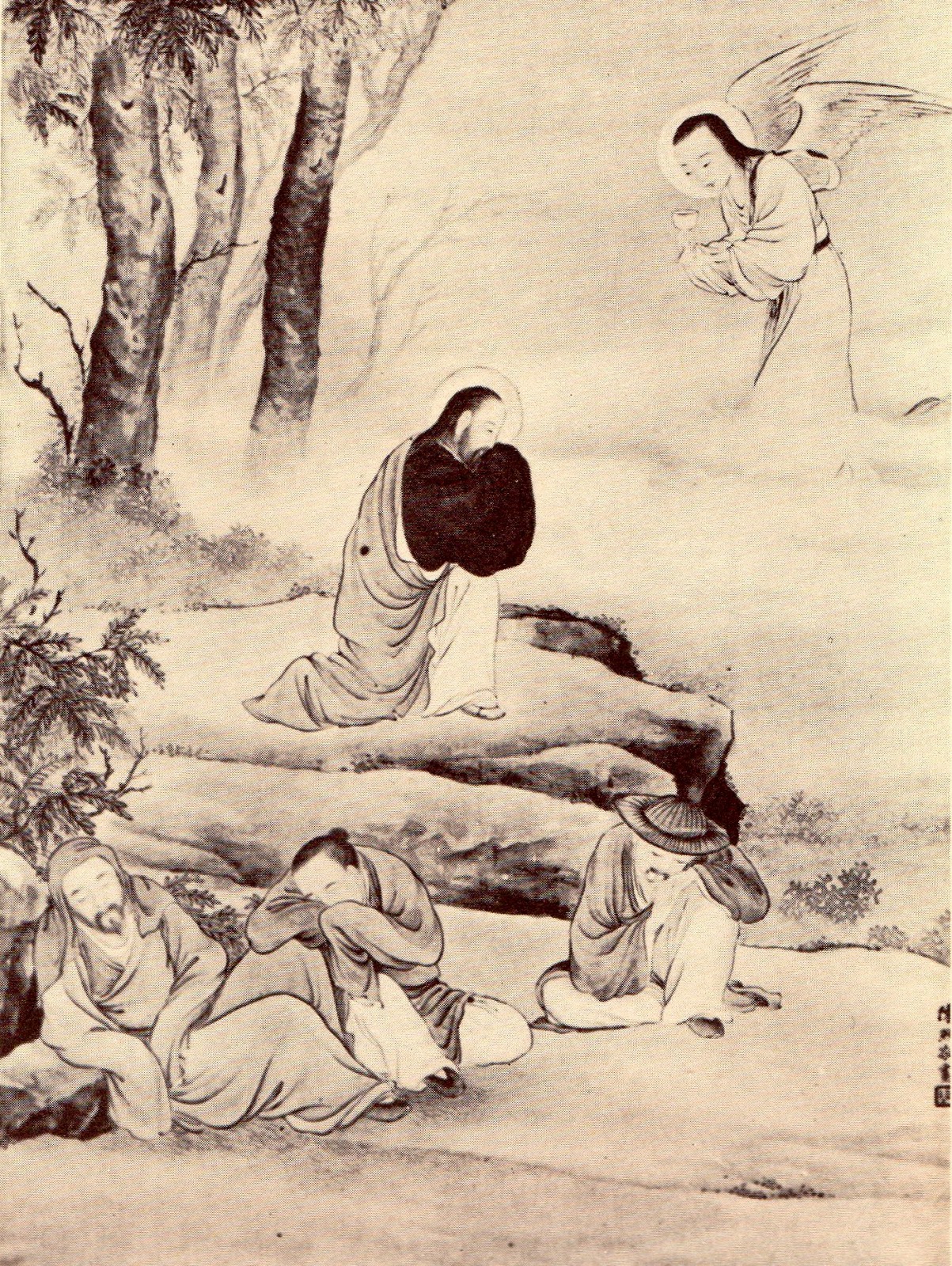
In looking at the two images below, it's amazing that the same scene, from the same source, could be so different as to style and rendering. In art, as in religion, the native culture makes a tremendous difference in how people see, Jesus. The real tragedy occurs when one culture sees "their" Jesus as somehow better than that of others.
Gethsemane, 1928, Luke Chen

Gethsemane, 1954, Walter West (Native American)
Praying at Gethsemane, 1999,
He Qui (Chinese)
The Native American painting by Walter West (above) offers yet another cultural interpretation of scriptural text. Cultural influences are not always so evident as seen in the work of Chinese painter, He Qui's Prayer at Gethsemane (left) from 1999. It is not so much Chinese as falling within the realm of an international, cubistic style more in line with Abstract Expressionism. Until recent years, the vast majority of all religious art has been realistic in style and narrative in content, placing spiritual values ahead of those having to do with art. In gathering visual material for this posting, most of it came from religious resources rather than those having to do with art. For centuries, that has tended to be the case as art was seen a nothing more than just another means of spreading the word of God. Postmodern artists are not unaware of this past functional element, but today, they also feel free to view spiritual themes as just one of many serving an inspiration function in support of their art.

Thursday, May 1, 2014

Leonor Fini

Leonora Fini Self-portrait
 
Self-portrait with Scorpion,
1938Leonor Fini
Few things in art fascinate me more than artists' self-portraits. In writing about artists, it's always frustrating to find those who have seldom or never painted themselves. In rare cases, even photos of the artist are hard to come by. On the other hand (or face), sometimes, in perusing artists' work one can be nearly overwhelmed with the surprising number of self-portraits. Of course, Rembrandt and van Gogh, are the first to come to mind, in this regard; but quite a few others rival them for sheer numbers. Of course, most of these rivals are men (male vanity?), but as female artists began to proliferate in the early 20th century, women also began to paint themselves quite frequently (with something other than makeup, that is). Of these, one of the most prolific (perhaps the most prolific) was the Argentine-born artist, Leonor Fini.

Self-portrait with Kot and Sergio, 1955, Leonor Fini
--one of her best works, suggesting a ménage a trois.
Self-portrait 1938, Leonor Fini

Leonor Fini was born in 1907 in Buenos Aires, though she grew up and lived most of her life in Europe (Trieste, Milan, and Paris). She was a very beautiful woman, a fact that seemingly was not lost on her or anyone she came in contact with. That list reads like a who's who of early 20th century European artists, including names such as Paul Éluard, Max Ernst, Georges Bataille, Henri Cartier-Bresson, Picasso, Jean Cocteau, Giorgio de Chirico, and Salvador Dalí. She was married once, but only briefly to Fedrico Veneziani, and judging by the major emphasis in her art content, she seems to have preferred women to men. However, Fini often traveled about Europe by car with two or more male friends. On one such jaunt in 1933, the famous photographer, Cartier-Bresson photographed her nude in a swimming pool with André Pieyre. The photo sold at auction not long ago for over $300,000 (a record for Cartier-Bresson). I wish I could show it here. Though not really obscene, it's a little too erotic for this venue. Her Self-portrait with Kot and Sergio (above) dating from 1955 would suggest she was possibly bisexual.
 
Visage en Rouge, Leonor Fini
 
Self-portrait, 1941, Leonor Fini
 

A self-portrait? Leonor Fini, June, 1947
Leonor died in 1996 at the age of eighty-nine. In surveying the sheer number of her authenticated self-portraits painted over her lifetime (more than a dozen), it quickly becomes apparent that she also drew and painted any number of images which have not actually been so labeled, but are, in fact, self-portraits. On top of that, quite a few of Fini's paintings feature faces that bear a striking resemblance to her own as in her Visage en Rouge (above, left). It would seem that whenever she was in need of a model, she simply looked in a mirror. Despite all the self-portraits, Leonor Fini was much more than an egotistical portrait artist. During the course of her lifetime she painted numerous others besides herself (mostly women), authored three novels, rendered watercolor magazine covers, (as evidenced by the Harper's Bazaar cover from 1947, right), and illustrated numerous literary classics. She also designed elaborate costumes for the theater, opera, and movies, while still finding time for her greatest love--Persian cats (as seen in her Seven Cates, bottom). At one time she had seventeen of them. They shared her bed as well as her table at dinner, wandering about, nibbling what they liked. If guests objected, they ceased being guests.

Seven Cats, Leonor Fini