Click on photos to enlarge.
Showing posts sorted by relevance for query Arno River. Sort by date Show all posts

Saturday, May 16, 2015

Renaissance Cities--Pisa

Piazza del Duomo, Pisa, Italy                             
Inasmuch as I've already dealt with the Italian city of Pisa's major malfunction, I won't dwell on it here. I'll post one photo of it (above, in which it barely leans at all) and that's it. I promise. Besides, there's ever so much more to Pisa than a certain architect's worst nightmare. I realize that like writing about Washington, D.C. and ignoring the big, white obelisk in its center. But after all, the city has some twenty other churches all of which stand pretty much upright and many of which are at least as impressive, interesting, historic, and perhaps even more beautiful than its cathedral. For a city with a modest population of but 89,373 residents, that's a pretty impressive number. One of them, the Church of Santa Maria della Spina (below), was even designed by a famous Renaissance architect--Giorgio Vasari.

Santa Maria della Spina façade
designed by Giorgio Vasari.
(Spina is Italian for thorn.)
The right side of the church, one
of the finest example of Gothic
architecture in Italy. 
Hypothetical maps.
Unlike most of the other major cities in Italy during the Renaissance, Pisa was a city in decline, a city that had literally seen its better days during the medieval period and which, by then had come under the thumb of Florence, its much more powerful sister just up the Arno River. In fact, the Arno river was one of the reasons the city was in decline. It's believed by experts that during the 5th-century, the city of Pisa had been a seaport as seen in the upper map at left. However, as the Tuscany area of northern Italy grew in population during the next six hundred years, and growing grapes grew in popularity, the rolling hills were cleared for farming. When that happens, over a period of centuries, erosion happens. In effect, silt from the river killed the harbor. By the 11th-century, (see map at lower left) the once fine harbor had became a swamp. Mosquitos arrived; malaria became a problem. (The same thing had happened to the biblical city of Ephesus, only a few centuries earlier). Ironically, this scenario may also account for the precipitous lean of a certain 12th-century cathedral bell tower. In comparing the medieval map below to the one at upper left, it seems possible that its location was on (or very near) the ancient shoreline, which would account for the differences in the load bearing qualities of the soil beneath the tower.
 
A map of Pisa dating from the medieval times. The cathedral and its bell tower are indicated in the upper left corner of the walled city. The harbor swamp appears to have been drained by a moat/canal to create farmland just outside the city walls.
Medieval City Gate, Via San Ranierino, Pisa
As Italian cities go, Pisa is a very old city. There's some debate as to which ancient civilization first settled the area but traces of communal living date back to at least 500 B.C., long before the Romans came and built the first city on the site. With its fine harbor, Pisa became an important trading center with a sizable fleet of ships, which also meant a sizable navy to protect the city and its trade routes. A sizable navy also means a sizable inclination toward naval warfare either offensive or defensive. And, over the centuries leading up to the Renaissance, Pisa had seen a sizable amount of both. Even as its harbor disappeared, ships could still simply sail up the Arno to load and unload goods. Pisa's major rival was Genoa, just up the coast and eventually cities in Sardinia, and along the northern coast of Africa. And, as they say, you win some and you lose some.
 

The interior of the Pisa Cathedral in all its medieval Romanesque glory.

A medieval Pisa watch tower.
(It only appears to lean.)
As time went on, the Pisanos lost a few more battles than they won, culminating in 1406 with their being conquered and occupied by the Florentines. During the Renaissance years, there was enough political intrigue and military treachery for a dozen good Italian operas. At one point the city actually won back its independence from Florence. At yet another point in time, the city was literally sold, lock, stock, and leaning barrel to a wealthy family in Milan. No longer an important trading center, its seaport having migrated several miles down the ever-lengthening Arno River to Livorno, Pisa eventually (and permanently) lost its independence once more to Florence. Of course, by that time, Pisa didn't need much independence or a seaport, they'd become a lively tourist attraction.
View of Pisa, ca. 1859, David Roberts
(Notice, no bell tower.)


Thursday, May 23, 2013

The Uffizi, Florence, Italy

The Piazzale degli Uffizi, designed by Giorgio Vasari
If you trek halfway around the world to visit the Uffizi, don't go on a Monday. They're closed on Mondays, also the Galleria dell'Academia, the second best (and much smaller) art museum in Florence, Italy. Unfortunately, I speak from sad experience. I can understand the need to close up one of the greatest art museums in the world one day a week (everyone, even Michelangelo's David, needs to stand down and rest a little). But to close both museums on the same day...I was, I think, justifiably outraged. However inasmuch as I hadn't bought my entry ticket in advance, I also missed waiting in line up to five hours to get in. I did get to see Palazzo Vecchio (and the David copy outside) as well as the marble sculptures under the Loggia dei Lanzi (those not boarded up for restoration).
 
Tribuna of the Uffizi, 1772-78, Johann Zoffany--more art than art museum.
The Uffizi (pronounce U-feet-zee) is one of the oldest art museums in Europe (older than the Louvre). Officially called the Galleria degli Uffizi, the museum was opened to the public in 1765, which makes it older than the United States. The building itself is a couple hundred years older than that, designed by the painter, architect, and art historian, Giorgio Vasari in 1560. It was originally an office building (Uffizi means office in Italian) for Cosimo de'Medici and his Florentine magistrates. Completed in 1581, though technically an office building, it has always served somewhat as an art repository, first for the de'Medici family and their burgeoning stash, and then, after they were booted out, for Florentine art in general, which gradually crowded out all the desks, chairs and file cabinets.
 

The Vasari corridor, a (very long) artists' hall of fame.
Today the Uffizi lines both sides of the street leading from the Arno River to the Piazza della Signoria, the town square (one of several, actually). The street is really the very elongated courtyard of the museum, which rises more than five stories straight up on each side. On the river end of this street Vasari created an architectural "screen" which effectively terminates the narrow vista without actually blocking it. High above is what may be Vasari's most unique creation, known today as the Vasari corridor. One might call it the first "skywalk", a passage approximately fifteen feet wide and about one kilometer in length which snakes from the Palazzo Vecchio, across the upper level of the Uffizi, then up the river to the Ponte Vecchio, crossing the river, then over and around the Florentine skyline to the Pitti Palace where Cosimo had taken up residence as ruler of the city. He wanted avoid traffic as he rode his horse to work each day. The area of the corridor passing over the Uffizi is now used to display portraits of the world's greatest artists (separate ticket required).

The Arno flows placidly by Vasari's south portal of the Uffizi.
As might be expected with any museum more than two hundred years old, the Uffizi has had its ups and downs. It was damaged by bombs during WW II, a devastating flash flood in 1966, and a car bomb in 1993 (probably the Sicilian mafia) which effected the Arno front of the building, destroying several frescoes inside. The flood brought water as high as seven feet in much of Florence, though fortunately, Vasari did not build the Uffizi at street level so the museum escaped that disaster with far less damage than many other Florentine antiquities.

In 1966, the Arno did not just flow by, but lingered inside the Uffizi for some 24 hours,
 while giving all of Florence a Venetian look. (Compare this photo to the one above.)
This is not the place to go if you don't like crowds. If you're familiar already with the art the museum houses, it's satisfying to know you've "been there, done that" in having seen them first hand, though in most cases, actually getting close enough to study the works, of even linger long enough to do so, is beyond realistic. And though it's a very big museum, it's not the Louvre or the Hermitage or the Met. It does not overwhelm with sheer size and content. It begins with Giotto's Ognissanti Madonna from around 1310 and ends with two or three Rembrandt self-portraits some 350 years later. Basically it's everything you'd ever want to know and see from the Italian Renaissance with a smattering of pieces from the North.

The Birth of Venus, 1485, Sandro Botticelli
The Uffizi is where you'd go to see Botticelli's Birth of Venus (above), Michelangelo's Doni Tondo, Titian's Venus of Urbino, Verrocchio's Baptism of Christ, Durer's Adoration of the Magi, Leonardo's Annunciation, as well as works by Uccello, Duccio, Cimabue, and Artemesia Gentileschi (if you've got a strong stomach). Although you'll see a few pieces of sculpture within the walls of the Uffizi, most of what the de'Medici once possessed has been moved across town to the Bargello. Likewise, you'll have to check out the Academia to see Michelangelo's original David. Tickets to see all this at the Uffizi are (full price) twenty-one Euros (about $29) per person with discounts for children and senior citizens. Just don't go on Mondays.

The Uffizi's gallery of artists' self-portraits, circa 1890
--not the place for the nearsighted or those with a stiff neck.


Monday, August 26, 2013

Flooded Art

The mud of the Florence flood, November 4, 1966.
Santa Croce Basilica well before
floodwaters crested around eight p.m.
After several days of hard rains, the dams holding back the floodwaters of Tuscany's Arno River in Italy threatened to give way. November 4th, 1966,  4:00 a.m., fearing even greater destruction if the damns broke, engineers began a controlled release of waters. Within hours a wall of water hit Florence, Italy, traveling at an astounding thirty-seven miles per hour. By ten a.m. the square in front of Santa Croce Basilica (left) in central Florence was under water, eventually reaching a height of 22 feet. With the water came even worse, mud, and oil from ruptured tanks on the outskirts of the city (top). There was no gas or power with many areas cut off from communications. The greatest art disaster in modern times was under way. Florence would never be the same again.


The floodwaters reached well up into
the second floors of many buildings.
I visited Florence some thirty-five years later. The water was gone; so was the nearly three feet of mud it left behind. The Arno river appeared serene and harmless. Stories recounted by guides seemed hard to fathom. Only high-water marks on the walls of some buildings gave any hint of the devastation they had encountered. In a city full to the brim with valuable ancient architecture, books, and art, any water at all reaching street-level brings with it costly, sometimes irreparable damage. All during the day, Florentines watched in helpless horror as the waters continued to rise, inundating valuable works inside Santa Croce, the famed doors of the Baptistery, priceless paintings on the lower level of the Uffizi, and dozens of other well-known repositories of the city's cultural treasures. Florence hadn't seen such damage in more than four-hundred years (1557). Moreover, 101 Florentines lost their lives due to the flood.
 
A group, which came to be called
the Mud Angels, worked tirelessly
to try to rescue tens of thousands
of books seen here stacked several
stories high for drying.
 
In writing about the Uffizi (05-23-13) I briefly discussed the effect this flood had upon the art and artifacts housed there. However the museum, because of Vasari's elevated main floors, was relatively unscathed as compared to Santa Croce (above, left), the Duomo, the Baptistery, and especially those structures housing Florence's long, detailed, written history. As bad as the damage was to works such as Cimabue's Crucifix, Ghiberti's bronze Gates of Paradise door panels, or Donatello's wooden sculpture, Magdalene Penitent, and others, such pieces constituted a manageable number and, except for the Crucifix, could be restored pretty much to their pre-flooding condition. Far worse, however, was the widespread devastation the water wreaked upon thousands of priceless printed volumes and manuscripts on paper or parchment. Especially hard hit were the collections owned by churches and government archives going back hundreds of years. Damage to various holdings ranged from thirty to one-hundred percent.
 
Donatello's 1453-55 Magdalene
Penitent was restored to a condition
actually better than before.

Cimabue's Crucifix (ca. 1288) was found more than half submerged, flecks of paint floating in the water around it. Though Donatello's Magdalene Penitent and the baptistery doors were eventually restored, damage to the crucifix was irreparable. The face and body from the knees to the shoulders was virtually destroyed. Floodwaters reached about half-way up on the crossbar. The damage is especially noticeable in comparing the before and after images (below). Ironically, had the crucifix not been removed from its original placement over Santa Croce's high altar in 1566, it would have remained well above the floodwaters. However, at that time, the gigantic, fourteen-foot work was moved to the church's refectory (dining hall) where it was hung low on the wall. Four hundred years later, it's placement proved to be too low.


Cimabue's 1288 Crucifix before
the 1966 flood.
The Crucifix after the flood.


.

Wednesday, July 20, 2011

Georgio Vasari

Self-Portrait, Giorgio Vasari
As a painter and devotee of art history, I've always had a strong kinship with the Mannerist painter Georgio Vasari. Vasari had the great good fortune to be born in 1511 at the height of the Italian Renaissance near its cradle, Florence, Italy. As a young man he was both an artist (primarily frescoes) and a scholar. For ten years he traveled the length and breadth of the Italian peninsula studying the art and artists of his time, talking with them, copying their work, and growing into a remarkably intuitive expert on art and architecture for the time. At the age of 31, he found himself in Rome and fell into the artistic circle of the wealthy Cardinal Farnese who obtained for him his first commission, a series of paintings for the Vatican Chancellery.

                                                                                         (Photo by Markus Bernet)
The Vasari Corridor as it crosses the Arno
River, the upper-most level of the Ponte
Vecchio
In his spare time, Vasari began organizing the notes from his travels into a manuscript which he had published in Florence in 1550. Bearing the auspicious title, Vite de piu eccelenti architetti, scultori e pittori, popularly known as The Lives of the Artists, his book was the first book even written solely devoted to art history. In it he drew heavily from his close encounters with the great Michelangelo Buonarroti whom he'd met as a young man and whose work (especially his painting) he'd studied intensely. Apparently Vasari had also studied Michelangelo the architect as well for it was about this time when he undertook a five-month construction project for the Grand Duke of Florence in which he designed and built a raised walkway called the Vasari Corridor, which connected the Pitti Palace with the Uffizi (offices). The remarkable link was almost a full kilometer long, zigzagging over and across the streets of Florence, through a church, across the Ponte Vecchio (a bridge already lined with numerous shops), then along the banks of the Arno River in what amounted to the first ever cross-town pedestrian walkway. Today, lined with some 700 paintings from the Medici collection, it is without doubt the longest art museum in the world.

Among his other firsts, in 1561, Vasari founded one of the earliest art schools, the Florence Academy of Drawing. But despite his remarkable contributions as a painter, educator, and architect, Vasari is primarily treasured today for his "Vite" now simply known as Vasari's Lives.  It is basic required reading for any would-be art historian. There is some disagreement among scholars as to who first coined the term "Renaissance" to describe the peak period of Italian art which Vasari illuminated in his book, a second edition of which he published in 1568. But there is little doubt it was Vasari who first recognized that this burst of creative artistic energy was a unique phenomenon, and that he was the world's first, true art historian.

Wednesday, January 18, 2017

Samuel Colman Jr., American Painter

Picturesque Landscape with Rainbow, Samuel Colman
A little over three years ago, I began to write a piece on the American painter, Samuel Colman. In the process I began to encounter paintings which, for all the world, looked to have been done by two different artists, though all were attributed to Samuel Colman (not Coleman). It took me several perplexing minutes to come to the realization that they were, in fact, painted by two different painters. Both had the same first and last names with the strange spelling of the family name, and both painted landscapes. There any similarities ended. One Samuel Colman was British, born in 1780, and whom died in 1845. The other was an American landscape painter born in New York City in 1832. This left me with the quandary as to which one to pursue. I chose the British painter in that his life and work seemed far more interesting than his American counterpart (an opinion I've not changed, by the way).
 
By the 1860s, the Hudson River was no longer picturesque.
Ships Unloading, New York,
 Samuel Colman
However, on the theory that everyone de-serves a second chance, in once again coming across the work of the American Samuel Colman Jr. today, I've decided to take a closer look at this belated Hudson River School artist from a fresh perspective, not in comparing his work to that of the British artist, but letting it stand on its own merits. In doing so, if we make comparisons, it should be an "apples to apples" judgement, his works compared to other Amer-ican landscape painters. It doesn't take long to see that Samuel Colman Jr. is no Albert Bier-stadt, no Edwin Church, no Thomas Cole, nor Thomas Moran. He does compare favorably with Asher B. Durand whom he's believed to have studied under for a brief period. In act-uality, Colman was second generation Hudson River School at a time when the cutting edge of American landscape painting was moving in-exorably westward along with the American frontier. The fact that we see in his paintings early steamboats on the Hudson (above) indicates that the river had become "civilized" and on the verge of being industrialized.

Ausable River, Samuel Colman
Samuel Colman was born in Portland, Maine. His family moved to New York when he was a young child. His father, a well-known bookseller and an established dealer of fine engravings, had a clientele of artists and authors that provided an early exposure to the New York City art scene which sparked Colman’s interest in painting. At the age of eighteen, the aspiring artist began to develop his technique (probably under the instruction of Durand). Colman gained an appreciation for the natural beauty of the American landscape as his artistic approach advanced so quickly he was elected an associate of the National Academy of Design in 1854. The Hudson River, Lake George and the White Mountains were all sources of inspiration for the artist during the 1850s.


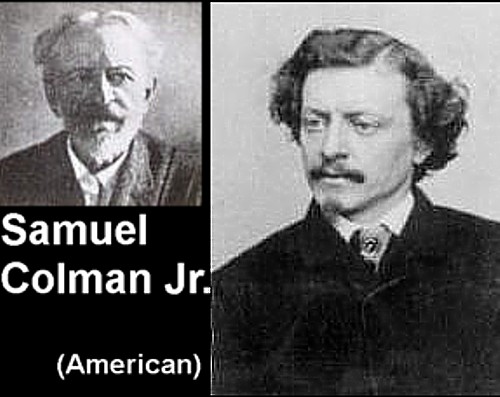
Colman in the 1860s and shortly before his death in 1920.
To his credit, Colman recognized the migrating trend in landscape art as it moved westward (though perhaps belatedly). After the Civil War, the art of watercolor became popular. Colman mastered this highly portable medium then took it westward, using it to create studies for later works in oil, though in many cases, his watercolors hold up quite well as works of art in their own right. His Late November in a Santa Barbara Canyon, California (above), has a spontaneous vigor found in the work of few western artists at the time, demonstrating a sensitivity for the minutiae of the west alongside the rugged grandeur seen in his Solomon's Temple, Colorado (upper image), painted during a later trip west in 1888.


American landscape art and artists moved westward after the Civil War.
In 1860, Colman left the country to participate in an important rite of passage for many 19th-century American painters: the Grand Tour. Although his wanderlust first led him to France, he was later drawn to less-frequented areas throughout Spain and Morocco, becoming one of the first American artists to visit these exotic locales. In the years that followed, Colman became an inveterate traveler, many of his works depicting scenes from foreign cities and ports. After he made his first trip abroad to France and Spain in 1860–1861, he returned for a more extensive four-year European tour in the early 1870s in which he spent much time in Mediterranean locales. Colman depicted the architectural features he encountered on his travels: cityscapes, castles, bridges, arches, and aqueducts feature prominently in his paintings of foreign scenes.

Colman found the exotic Mediterranean area even
more enticing than the American west.
Colman's art became more diverse late in his life. By the 1880s he was working extensively as an interior designer, collaborating with his friend, Louis Comfort Tiffany on the design of Mark Twain's Hartford home, and later on numerous Fifth Avenue beaux-arts and Victorian mansions. Colman also became a major collector of Asian decorative objects, while also writing two books on geometry and art focusing primarily on art theory. His, Nature’s Harmonic Unity: a Treatise on its Relation to Proportional Form, was published in 1912, while the second book, Proportional Form, was released five days before his death in 1920. Colman’s obituary in the New York Times describes him as a “foremost American landscape painter and noted etcher."

Along the Arno, Florence, Italy
ca. 1875, Samuel Colman


Saturday, March 5, 2016

Painting Bridges

The Brooklyn Bridge, Leroy Neiman
If you're a landscape artist of some standing, the chances are you've painted at least one bridge sometime during your lengthy contribution to art history. Speaking of history, the experts tell us that the oldest existing bridges today can be found in Greece dating back to the 13th-century BC. I doubt they've been painting them that long, but artists have long liked painting bridges. I've painted a few highly salable covered bridges (bottom, paintings, not the bridges themselves). Years ago I painted the bridge crossing the Muskingum River into my hometown. That was about 1990. They tore it down shortly thereafter and replaced it with a strange, asymmetrical, concrete arch affair which I also painted. Then I went back in history and found photos of the original steel truss bridge, which washed away in the devastating 1913 flood. I sold all three to a local restaurant where, I assume, they still hang today. For the most part, bridges are graceful, sometimes quite beautiful, and they're laden with a boatload of symbolism. They bypass problems, they smooth out the rough spots in our lives, and they connect things, both literally and figuratively. You know something is important when its noun form also becomes a verb. That is to say, bridges bridge.

The Langlois Bridge at Arles, 1888, Vincent van Gogh
Leroy Neiman's Brooklyn Bridge (top) is one of my favorites; but some other very important artists have also painted bridges, though most of them are far less important than the New York City landmark. Vincent van Gogh painted The Langlois Bridge at Arles (above), in 1888. It's still there today, likely because van Gogh painted it. The Impressionist, Alfred Sisley, painted The Bridge at Villeneuve la Garenne (below), 1872. It looks to be a little more important a thoroughfare than van Gogh's modest little span. So far as I know it is also still in place.

The Bridge at Villeneuve la Garenne,1872, Alfred Sisley
Without doubt, the consummate bridge painter of the Impressionist era would have to be Claude Monet. He may also be the only artist who ever designed and built his own bridge, literally painting it (a pale green) then setting about painting pictures of it. His Japanese Bridge over the lily pond at Giverny was the subject of no less than twelve painting efforts, between 1897 and 1899 (mostly 1899). I've seen it. I've walked across it. I only wish I'd had time to paint it, although the skies were drizzling rain at the time. Rain or shine, I could see why Monet loved it so much and why so many artists since his time, in visiting his home and gardens at Giverny, have also set up their easels before its graceful wooden beams (below).

The greatest bridge builder and painter of the Impressionist era.
For the most part the bridges artist paint are more important than the artists who paint them. In fact, their social importance and architectural/engineering beauty is likely why artists paint them. One of the oldest bridges in Europe spans the Arno River at Florence, Italy. The present Ponte Vecchio (below), built to replace some earlier wooden spans washed away by flooding, was completed in 1345 on a site where the river is at its narrowest, and where a Roman bridge had stood more than a thousand years earlier. As bridges go, it's not very attractive. In fact, of all the bridges ever painted by artists, this one vitally needs the artist's touch to imbue it with any sense of romantic beauty associated with most other such spans. Photographs actually tend to emphasize its uglier qualities. The Ponte Vecchio also has the distinction of being a key part of the first urban rapid transit system ever built. Designed by the famous art historian, painter, and architect, Giorgio Vasari in 1565, the Vasari Corridor passes over the shops along the bridge in order to connect the Palazzo Vecchio (Florence's town hall) with the Palazzo Pitti, allowing Cosimo I de' Medici to ride his horse to work each morning without encountering the rush hour traffic in the streets below. To enforce the prestige of the bridge, in 1593 the Medici Grand Dukes prohibited butchers from selling there. Their place was immediately taken by gold merchants. They're still there today where once hung out over the edge of the bridge the city's butcher shops (a great convenience for disposing of unwanted meat scraps). The bridge narrowly escaped destruction by the Nazis when they evacuated Florence in the waning days of WW II. It was the only bridge crossing the Arno left in place.

The Vasari Corridor remains today, though it's been turned into an art museum
featuring portraits of famous artists of the past from around the world.
Almost as old, and also in Italy, painters have long flocked to the famous Rialto Bridge crossing the Grand Canal in Venice. The present stone structure replaced two earlier bridges which had collapsed under the weight of spectators watching; parades of boats in the water below (that must have put a damper on the festivities). It was designed and completed in 1591 by the appropriately named Antonio da Ponte (Ponte means bridge in Italian). So radical was it's design at the time many feared to cross it, expecting it to suffer the same fate as its predecessors. They needn't have worried. The ultimate in Venetian bridgework has been there now for over four hundred years.

Big name artists such as Venice's own Canaletto and the American painter John Singer Sargent have all painted the Rialto. For some unknown reason, Sargent chose to paint under the bridge. Maybe it was raining at the time.
One of the strangest looking bridges ever painted by artists (or ever built for that matter) is London's Iconic Tower Bridge, completed in 1894 to span the Thames without, at the same time blocking it to ship traffic. It's a drawbridge, the mechanical elements hidden inside medieval Gothic towers on either bank of the river, which are joined at the top by a then state-of-the-art steel truss span to allow workers to cross the rive while the bridge below is open to nautical traffic. It's often mistaken for the tuneful "London Bridge" which was not falling down but was, in fact, taken down and shipped block for block to a site in the Arizona desert as the centerpiece for a housing development.

It's in London but London Bridge it's not.
The other two most painted bridges in the world are both American suspension bridge, one each firmly ensconced on each coast. Unlike London Bridge, which the Brits sold to the Americans, the Brooklyn Bridge has never been sold, though many have tried. Designed and build in 1883 by John Augustus Roebling and later his son, Washington Roebling, at great cost both financially and in the loss of lives, the Brooklyn Bridge across the East River is actually a few years older than London's Tower Bridge, though decades ahead as to engineering and design. Like the Tower Bridge, it's stone towers have Gothic elements as seen in its pointed arches, but beyond that, with its Roebling invented steel cables, the two bear few similarities as to size and appearance. Starting about 1920, the American artist, Joseph Stella (below-left), practically made a career for himself churning out dozens of modernist paintings inspired by its design. Or, maybe he was just taking his cues from Claude Monet.

The Brooklyn Bridge definitely has a personality all its own, depending on how you look at it.
And finally, the "baby" of the bunch, the 1930s vintage Golden Gate Bridge across the entrance to San Francisco Bay is probably the most visually impressive of the whole lot. Though no longer the longest or tallest, or most trafficked bridge in the world, that hasn't kept daredevils, suiciders, or artists from taking advantages of its graceful, towering curves. Of all these bridges, this is the only one I've ever actually crossed, though I've seen from a distance the Ponte Vecchio (I was not impressed). I could never say that about the Golden Gate. Whether on it, or looking back at it from Marin County, its northern terminus, the only word that comes to mind is "awesome." I'm guessing all the artists below would agree with me on that.

By the way, the Golden Gate Bridge is a rusty red, not Golden.
Copyright, Jim Lane
The Millfield Bridge, 1970, Jim Lane
(I've never crossed this one either.)


Tuesday, November 8, 2016

Peter Blume

House at Fallingwater, 1937, Peter Blume
Few, if any, artists living and working today can claim not to have been influenced by one or more other artists. Even a so-called "self-taught" artist, presumably having no instructor from which to have derived influence, is unlikely to have learned his or her art in a vacuum. Artists are attracted to art, which means they are unavoidably attracted to other artists. And if not consciously, then at least subconsciously, they are influenced by them. These influences most often manifest themselves in a young artist's early works after which time, as the artist matures, they very often become heavily "coated" in their own developing style to the point that the influence of others if quite difficult to discern. But now always. Take the work of the Russian-born American artist, Peter Blume for example.
 
Home for Christmas, Peter Blume
In surveying Blume's work we can easily see influences such as Thomas Hart Benton, Giorgio de Chirico, Salvador Dali, Frank Lloyd Wright, and even Grandma Moses. Naturally not all these influences were absorbed at the same time, and some were stronger than others. Given the fact Blume is considered a Surrealist, the influences of Dali and de Chirico are not unexpected. But for a painter to be influenced by a leading architect of his time such as Wright, as seen in his House at Fallingwater (top) is quite rare and surprising. Although Blume was not self-taught in the mold of Mary Robertson (Grandma) Moses, he often displayed a rare combination of Folk Art imbued with Surrealism. Blume's Home for Christmas (above), is pure folk art while his The Parade (below) demonstrates this synthesis.
 
The Parade, 1930, Peter Blume. Notice the Cubist influence.

Peter Blume was born into a Jewish family in 1906. In 1912, his family emigrated from Smarhon, Russia (present-day northeastern Belarus), to New York City where they settled in Brooklyn. Blume studied art at the Educational Alliance, the Beaux-Arts Institute of Design, and the Art Students League of New York. He established his own studio by 1926 as he came to enjoy the patronage of the Rockefeller family. Blume married in 1931, but had no children. He received a Guggenheim Fellowship in 1932, which allowed him to spend a year in Italy. There he became an admirer of Renaissance technique, picking up the habit of and making cartoons (full-size drawings) before putting his work on canvas.
 
Photos taken over the course of Blume's sixty-six year career.
Blume's big break as an artist came In 1934 when his South of Scranton (below) was included in the Thirty-second Carnegie International exhibition in Pittsburgh. The twenty-seven-year-old artist was thrust into national attention when the painting was awarded first prize by a distinguished panel of judges including Elizabeth Luther Cary of the New York Times, the American artist Gifford Beal, and Alfred H. Barr, Jr., director of the Museum of Modern Art. Public outcry at the Surrealist nature of the painting prevented the Carnegie Institute from purchasing it for their collection. However, in 1942 it was acquired by The Metropolitan Museum of Art after winning a prize in the major exhibition "Artists for Victory."

South of Scranton, 1934, Peter Blume
The influence of the famous Missouri painter, Thomas Hart Benton can be seen to some degree in several of Blume's works, but most noticeably in his The Steamer (below) from 1929, well before Blume became famous. Besides the elements of folk art, and Surrealism, at various periods in his career Blume also displayed influences as diverse as Precisionism, Parisian Purism, and (most surprisingly) Cubism. The work of Peter Blume is sometimes listed as "magic realism", a variation of the American style of the era, which offers images of everyday life, combined in a cartoonish manner that gives the viewer a sense of wonder and imagination.
 
The Steamer, 1920, Peter Blume
While in Rome Blume had the adventure of seeing the celebrations for the tenth anniversary of the Fascist March on Rome. He expressed his Fascism with the grotesque Eternal city (below), from 1934-37. It became an instant source of controversy. The politically charged work portrayed Benito Mussolini as a jack-in-the-box emerging from the Coliseum. Many consider it his most important painting.
 
The Eternal City, 1934-37, Peter Bloom
Blume's works often portrayed destruction and restoration simultaneously as seen in the artist's Recollection after the Flood (below) from 1969, which depicts the victims of the 1966 Flood of the River Arno in Florence along with art restorers at work. It offers a rare opportunity to study the similarities and the differences between Blume's full-size, preliminary cartoon and the final painting. Peter Blume was elected into the National Academy of Design in 1948 as an Associate member, becoming a full member in 1956. He died in New Milford, Connecticut, in November of 1992. Today his works can be found in major museums around the world.
 
Peter Blume's 1969 tribute to the victims and restoration workers following the catastrophic flooding of Florence by the Arno River in 1966.

Although landscape painters have often been known to paint
a series of works depicting the same scene during the four
seasons, Blume may well be the only Surrealist artist to do so.
Usually such works are created within months of one another.
Blume's series, however, spans more than fifty years.