Click on photos to enlarge.
Showing posts sorted by relevance for query Giuseppe Arcimboldo. Sort by date Show all posts

Friday, October 10, 2014

Giuseppe Arcimboldo

Autumn and Winter, 1573, Giuseppe Arcimboldo--weird
Giuseppe Arcimboldo Self-portrait
Yesterday (item below) in discussing the art of Charles Dana Gibson, I alluded several times the interrelationship between art and humor. Until illustrators and cartoonists began to toy around with their talents during the 19th and 20th-centuries, quite frankly, there wasn't much of one. Even had there been, humor (relying on the vital element of time and place) tends not to have an exceptionally long "shelf-life." We probably wouldn't understand centuries-old humor in any case. In the past, art, was the primary means by which culture, events, personalities, and and daily life could be explored visually and preserved. It was simply too important to be dallied with in the realm of humor. As a result, we often come away thinking our forebears had little or no sense of humor and thus lived a rather drab, humorless existence. Although I didn't live back then, in digging a little into the various fine arts, I find clues to the fact that this was not the case. An example of this is the work of the Italian portrait/still-life artist, Giuseppe Arcimboldo. People back them must have had a rather broad, forgiving sense of humor, or this weirdo would have spent most of his life locked up, or in an early grave.
 
The Cook, 1590, Giuseppe Arcimboldo. It's a wonder his cook didn't poison him.
The Librarian, ca. 1590,
Giuseppe Arcimboldo
Although the history of art is likely populated with any number of artists whom most people would consider "weird," I reserve that term for only the weirdest of the lot. Moreover, it's not just his art that was weird, Arcimboldo wore the "weirdo" badge with great honor, not to be seen again until the coming of Salvador Dali some four-hundred years later. However, unlike Dali's pop-eyed expressions and his silly little moustache, in looking at the Giuseppe Arcimboldo self-portrait (above, right), there's nothing particularly weird about his appearance. Nonetheless, there were those living in his time who felt the man should be committed to some kind of post-Renaissance mental institution--those without a sense of humor, apparently. Among them were likely cooks (above), gardeners (below), lawyers, and librarians (right). Arcimboldo's still-life paintings were exquisitely rendered, and the fact that he arranged some of them to look like people when inverted was really quite clever for its time. It was his titles, however, which offended--librarians especially (right).
 

The Vegetable Gardener, 1590, Giuseppe Arcimboldo--something for the vegetarians.
The Four Seasons (four individual paintings),
1573, Giuseppe Arcimboldo
I've been award of Arcimboldo's art ever since doing an item on Food Still-lifes several months ago, but had never delved into the artist himself until today. Giuseppe Arcimboldo was born around 1526. His father was a designer of stained glass windows and frescoes for the local churches in Milan. As was common at the time, young Giuseppe started out in the plodding footsteps of his father, who apparently provided his son with the boy's only art instruction. However, about the time he turned twenty-one, Giuseppe decided he wanted to be a portrait painter. He married, then headed off to the Hapsburg court of Ferdinand I in Vienna where he became the court painter. There, around 1573, Arcimboldo began to dabble with anthropomorphic produce. His four allegory paintings, Earth, Water, Flora, and Air (bottom) from this period. From Vienna he moved on to Prague to satisfy the portrait vanities of Maxmiliann II and his son, Rudolf II.

Emperor Rudolf II, 1590,
Giuseppe Arcimboldo
It was in the person of Rudolf II, an ineffectual monarch, but an avid devotee of the arts, that Arcimboldo found a patron with a sense of humor broad enough to countenance his first fruit and veggie portrait (right), Ge depicted the emperor as Vertumnus, the Roman god of the seasons around 1590-91. The scandalous depictions of the various professions came about the same time or shortly thereafter. His critics couldn't decide if his paintings were simply funny, satirical, derogatory, or the product of artist insanity. In any case, he became collectible to the point Arcimboldo found it possible, and indeed, necessary to return to Milan in retirement where he continued painting for his own enjoyment until his death in 1593. Art historians have judged Arcimboldo to not only have been quite sane, but far ahead of his time (by several centuries, in fact) which, alone, is enough to cause myself and others to consider him weird.

Allegory of Earth, 1573, Giuseppe Arcimboldo
Allegory of Water, 1573, Giuseppe Arcimboldo--easily his ugliest painting.
Allegory of Flora, 1573, Giuseppe Arcimboldo
Allegory of Air, 1573, Giuseppe Arcimboldo.


Saturday, April 19, 2014

Food Still-lifes

Still-Life with Fruit, Nuts and Cheese (1613), Floris van Dyck (circa 1575–1651),
what you might have had for breakfast 500 years ago. 
What did you have for breakfast this morning? Cereal, bacon and eggs, Pop Tarts? I had a flatbread sandwich of Egg Beaters, low-fat Swiss cheese, with two turkey sausage patties. On the side I had grapefruit, and strawberry yogurt with (more or less) fresh strawberries added, topped with granola. I had café mocha to drink. I'm a believer in big breakfasts. What's the point in all this? The chances are, a good deal of what you had for breakfast today would have been highly unlikely five-hundred years ago. Much of your menu simply hadn't been invented yet in its present day, highly-manufactured form. It's not that the food is new. There were ham and eggs, breads and pastries, fruit and yogurt back then though we might have been ill-advised in eating them in the days before refrigeration. How do we know so much about food from the past? Art--still-lifes, particularly Dutch still-lifes, like the one above.
 
Copyright, Jim Lane
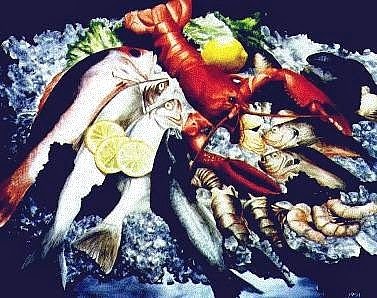
Seafood Buffet, 1991, Jim Lane, my own contribution to the cause
--a tantalizing feast if you love seafood. Dead fish if you don't.
Not long ago, chefs and historians were combing through their history books and their cookbooks trying to replicate the dinner menu from the Titanic on it's final night afloat. They were chagrined to realize how little they knew about many of the items served a mere hundred years ago. Some were simply incomprehensible. There was no one painting a still-life of the food that last night on the Titanic. (Jack Dawson was too busy painting his nude girlfriend.) Sex and food...two of the most persistent subjects in the history of painting. Man paints what's important to him. As far back as the ancient Greeks artists painted bowls of fruit. Legend has it they were so realistic they drew flies (it's unclear whether they meant the images or the artists). The Romans, being Roman, copied and tried to outdo the Greeks. Apparently, the flies were not impressed.

Fruit Basket, 1590, Giuseppe
Arcimboldo
Fruit Basket, 1590, Giuseppe
Arcimboldo
During the Middle Ages there was very little food painted--perhaps because there was very little food. God, war, and the gods of war were seemingly all artists cared much about. The wine culture of the Italian Renaissance fostered some of the first food still-lifes. Like little children, the Italians, such as Giuseppe Arcimboldo, sometimes played with their food as seen in his funny little Fruit Basket (above), from around 1590. When you invert the painting (as seen on the right), it becomes a funny little Italian. However, it was the Dutch who really pulled out all the stops when it came to painting food. One wonders if they ate half as much food as they painted. Of course, being such meticulous artists, by the time they were done painting, the food probably wasn't very appetizing (or even edible).

Un Coin de Table, 1895-1990, Paul Cezanne
Cezanne (above) was said to have painted apples until they rotted. For the Dutch there was a lot of meat, seafood, fruits, nuts, and veggies--quite the balanced diet. Like myself, breakfast seems to have been their favorite meal as might be guessed in seeing Still-Life with Fruit, Nuts and Cheese (top, 1613), by Floris van Dyck (no relation to Anthony). 


Still Life with Fruit and Ham, 1648-49, Jan Davidszoon de Heem.
I like my lobster better.
Cakes, 1963, Wayne Thiebaud,
Jan Davidszoon de Heem's, Still Life with Fruit and Ham, 1648-49 (above) appears quite sumptuous until the Dutch flies arise. The Dutch artist, Peter Aertsen, even managed to combine food and religion with his ghastly 1551 Butcher’s Stall With the Flight into Egypt (below). I like Dutch realism as much as anyone, but Aertsen's brand is enough to make me a vegan. The Holy Family must have longed for some Golden Arches, even if they were a mirage. Wayne Thiebaud's, Pop Art (that's Pop Art, not Pop Tart) Cakes, (left) from 1963, are more my speed.

Butcher’s Stall With the Flight into Egypt, 1551, Peter Aertsen.
The smell must have been quite...robust...on a slow day.
Though Thiebaud's cakes, individually and together, were and are works of the baker's art, Pamela Michelle Johnson's Cupcakes (below) most certainly are not. An entire nation nearly went into panic mode when it appeared Hostess would cease manufacturing this delicious little dietary nightmare. Pamela paints them with a hyper-realistic style which Dutch artists would, no doubt, approve, even if they might be somewhat mystified by the curlicues on top. However, the scale of this food still-life far exceeds that of even the most diet-busting, waist wasting, preservative packed, crème-filled, chocolate-iced, cupcake creation Hostess ever dreamed of.

Cupcakes, 2007. Pamela Michelle Johnson. I'm off to raid the pantry, now. 


Sunday, October 8, 2017

Figural Landscapes

Wassernixe (Mermaid), by digital artist, Hans Peter Kolb
There are landscape painters, and then there are figure painters. Occasionally a figure painter may fill in some empty space on his or her canvas with some semblance of a natural background. And, on rare occasions, landscape painters may populate their paintings with painstakingly painted people. But in general the two seldom meet. Today I came upon three Postmodern artists, Carl Warner, Jose Roosevelt, and Hans Peter Kolb, who have not only caused these two genres to meet, but have quite skillfully caused them to merge.
 
Cut Throat Valley, Carl Warner
One of the hallmarks of Postmodern paintings is innovation or "newness." In the olden days we called it originality. In Postmodern painting influences from artists of the past are either avoided, or highly subdued, in an effort to achieve a new purity of essence. If you're puzzled by the title, "Figural Landscapes," I'm using it here, perhaps even coining the label, to designate a landscape skillfully combined with a figure, or in some instances, more vice-versa. Artists have other names for such work. Carl Warner calls his figural landscapes "Bodyscapes." Jose Roosevelt calls his "Nature Figures." Hans Peter Kolb titled one of his digital works, "Human Nature," which seems as good a label as mine or any of the others. It's an indication of their Postmodern "newness" that no one has managed to suggest a label that sticks.
 
The work of Jose Roosevelt at times displays the surreal
influence of his idol, Salvador Dali.
Brazilian painter, Jose Roosevelt
Jose Roosevelt is a native of Brazil, born in 1958. He held his first exhibition in Brasilia when only twenty years old. Even then his compositions were full of dream-like symbolic im-ages. In 1988, he had the opportunity to show his paintings and drawings in Europe. Two years later, he set up his studio in Lausanne, Switzerland. Since then, he has shown his art in Switzerland, France, Italy, Belgium, Denmark and the United States. He has also illustrated classic books such as Alice in Wonderland, while also writing and illustrating graphic novels, and Tarot cards.


Carl Warner uses a mix of geographical and human terms to title his desert-like digital images.

Digital artist Carl Warner.
Carl Warner is a British photographer bas-ed in London. He turns human bodies, the folds of the skin and muscles, into real landscapes. Some are abstract portraits playing on the sense of space, offering a different view on human anatomy and our relationship to the human body. Carl War-ner challenges how we view the human body. His work is comprised of body parts organized in such a way that they re-semble massive landscapes foreground-ed against a neutral, tinted sky. Step a few feet away from your computer screen and you may feel like you are looking out at some Martian landscape. A very inter-esting perspective to consider the next time you think about (or look at) the hu-man form. Stumbling across something truly original is not easy in an era when most things having to do with art have already been done or thought of before. Warner's work has sometimes been compared to that of Giuseppe Arcimboldo who painted portraits of people made out of food back in the 16th-Century. It would seem Warner's applying the same process to landscapes is a progression of that idea.
 
Kolb's digital images often seem to take on the
form of monumental sculpture.
H.P. Kolb was born in 1957 in Heddesheim near Heidelberg, Germany. From the age of 14 he learned how to handle brushes and oil paints. However, Kolb first trained as a chemist before switching to media design in 1979. During this time Kolb worked independently as a traditional illustrator. Then in 1992, he began experimenting with digital images. Some six years later Kolb undertook training as a 3D designer. In the early days of digital imaging, Kolb developed a new interest: The digital airbrush. He was fascinated by the fact that all ideas and painting techniques can be implemented using a computer in much the same way as with an airbrush. In addition, the computer offered the possibility to greatly enlarge the images on the monitor, thus making it even more photorealistic and detailed. To this day, he has developed this technique into a perfection with which he occupies a special position in modern art. Even more astonishing is the fact that due to a birth defect, Kolb has no 3-dimensional vision. Because of this his spatial imaginative skills are above average. Power, reality, and visions speak from his pictures in his own distinctive style.


German digital artist, Hans Peter Kolb.


Three very different artists, each with their own distinctive style--one a painter, one a photographer, another a graphic designer. Two work digitally--yet each has latched onto a new, Postmodern combination of two, heretofore, largely incompatible genres. Yes, there are historical antecedents and influences from the past, yet they only serve to underline the fact that Postmodernism embraces rather than eschews the past so long as it is combined with genuine innovation to engender the requisite "newness" that Postmodernism demands.
 
Magic Mountain, Hans Peter Kolb


Saturday, October 11, 2014

Jan van Beers

The Funeral of Charles the Good, 1876, Jan van Beers.                              
(Parts of the painting are missing on each end.)                            
Jan van Beers ca. 1880s.
Yesterday I wrote regarding the "weird" 16th-Century Italian painter, Giuseppe Arcimboldo (the item directly below). Today, I'm here to point out that the 16-century by no means had a monopoly on weird artists or their weird art. I suppose it wouldn't be going too far astray to suggests that nearly all artists are weird in some respects. I know I am. I don't like to sweat. I'm adverse to physical labor. I'm getting so I don't paint much unless I can add a weird, Postmodern twist to what I do. I do my best work when I get up early and go to bed late (it's the time in between when I'm not so sharp). I'm also addicted to my computer (otherwise you'd not be reading this). Today we don't use the word "weird" so much as the term "idiosyncrasies." That makes us seem more normal. After all, everyone has idiosyncrasies, right? Artists just have weird idiosyncrasies. Jan van Beers had weird idiosyncrasies, to put it kindly.
 
Granvelle and the Witch, 1877, Jan van Beers.
Jan van Beers posing as
Sir Anthony van Dyck.
Perhaps his weirdest, van Beers and his artist friends like to dress up like famous people out of history and parade around Antwerp (he was Belgian) in costume (left). Van Beers and his friends also liked to dress up like figures from their paintings...even if they were women. Later in life, van Beers designed and had built a new home in Paris in which each room was of a different style decor. For this he was considered a madman. Born in 1852, and striving since childhood to become famous as a history painter, in 1876, van Beers' first came to notice in Paris with what was then (and perhaps still remains) the widest painting (horizontally) ever created, The Funeral of Charles the Good (top), which today hangs in Paris' Petit Palais, displayed in a hallway making it impossible to photograph except obliquely (even if photos were allowed, which they're not). I'm guessing, but it appears to be more than forty feet wide. It was the first painting ;van Beers ever sold and it brought a good price, 12,000 francs, yet the artist claimed that amount barely covered his expenses. The painting is a solid mass of portrait-grade, life-size faces and figures numbering in the high hundreds. He also rendered a similar effort on a slightly smaller scale, Granvelle and the Witch (directly above). Painted a year later, it generated a similar "ho-hum" reaction among jaded Parisian art critics. Of course by that time, history painting was waning in importance and van Beers was seen as something of a foreign interloper, more interested in becoming rich and famous than in creating great art. Harsh as that may sound, the French critics had him well pegged.

Elegant Lady, 1880s, Jan van Beers, typical of his society portraits and illustrations.
Bacchus Seated on a Barrel, 1886,
Jan van Beers, not the type
of work befitting a "serious" artist.
It wasn't easy standing apart from the enormous crowd of Parisian painters during the latter years of the 19th-century. Paris was the art capital of the world. Students and opportunists alike (such as van Beers) flocked there from all over the world in an attempt to make a name for themselves. Moreover, van Beers was nothing if not ambitious and persistent. He had the skills. He had few restraints. He would accept commissions for virtually any type of work (right) including illustrations and even advertisements. (Paris held the high ground in both these areas.) Art in Paris was serious business, the competition for commissions and critical acclaim cutthroat. French critics faulted van Beers for not taking art seriously. His efforts were seen as little more than publicity stunts. Once more, they were right.

Van Beers controversial 1881 painting. The real "sirene" is on the steps, not in the water.
Boy with a Humming Bird,
(before 1900), Jan van Beers
However, in 1881, having had little success at history painting on a grandiose scale, van Beers turned the tables on his critics,. He submitting to the Brussels Salon that year two very small, postcard-size paintings. One, titled La Yacht Sirene was painted in sepia tones utilizing exquisite, hyper-realistic detail. It depicted a young lady being escorted down the steps of a quay to a waiting boat to be ferried out to a yacht waiting in the middle ground of the scene. Almost immediately the Salon judges and critics accused van Beers of "photo-peinture", not just painting from a photo but having painted on a photo. The ever feisty van Beers challenged his detractors to prove their allegations by scratching off the paint in search of a photo. He offered a "bet" of one-thousand pounds if such evidence were found. In return, they were to be donate the same amount "...to my pet Home for Incurable Idiots" if no such photo was found.

An 1888 print of van Beers' commercial art.
When the Stars Set, (before 1900),
Jan van Beers.
The salon officials declined the bet, but van Beers later found that the image (the lady's face) had, in fact, been "defaced" in search for technical clues as to the amazing, nearly microscopic verisimilitude he'd rendered. One periodical defended van Beers, accusing his accusers of being "jealous of his commercial success" (above). Van Beers started legal proceedings to clear his name with the resulting scandal making headlines all over Europe. An informal investigation eventually deemed van Beers an "honest man." Indeed, the free publicity greatly increased the prices for van Beers' work. He died in 1927, a very rich "honest man."

Portrait of a Man, (date unknown), Jan van Beers. A self-portrait? There is a resemblence
to the photo (top, left). But even if it's not, the attitude seems appropriate.


Tuesday, November 21, 2017

Eduard Wiiralt

The Violinist, 1931, Eduard Wiiralt
 
Latvia, Lithuania, and Estonia are some-times referred to collectively as the "Baltic" countries. Indeed, they are all on the Baltic seacoast on northern Europe. Of course so are what we refer to as the Scandinavian countries as well--Sweden, Norway, Den-mark, and Finland. Of course Russia, Pol-and, and Germany all have Baltic ports but apparently each of those countries are too big or too important to get lumped together except in a general reference as northern Europe. Several years ago, my wife and I cruised the Baltic and I spent one day touring Tallinn, the capital of Estonia, and the smallest of the "Baltic countries."
 
Street in Sceaux,
1928, Eduard Wiiralt
 
Reclining Tiger and Cat, 1937, Eduard Wiiralt
 
Eduard Wiiralt
So far as I can tell, I've never written about an Estonian artist, although I did come up with an item on the Latvian painter, Auseklis Ozols, however he spent much of his life in the United States. The Estonian painter Eduard Wiiralt, though born in a small town called Goubanitzy near St. Peters-burg, Russia, in 1898, his parents moved the family to Estonia in 1909 when he was eleven, and inasmuch as his parents were Estonian, the Estonians have long since claimed him as one of their own, considered the best Estonian graphic design artist of his time. During World War I the young artist was educated in the Tallinn Arts and Crafts School. After finishing there in 1919, he continued his studies in the Pallas Art School in Tartu under Anton Starkopf. He created his first woodcuts and linocuts in 1916 and his first etchings in 1917. In 1923 Wiiralt visited the Dresden Academy of Art, in Germany, where he studied under professor Selmar Werner. Soon after he began his career as a book illustrator.


The Head of a Woman, 1916, Eduard Wiiralt
Women in Top-Hats, 1927, Eduard Wiiralt
Wiiralt's studies were interrupted by his participation in the Eston-ian War of Independence. In 1922–23, Wiiralt continued his training, as a grantee of the school, at the Dresden Academy of Art in Germany under the supervision of Professor Selmar Werner. Wiiralt returned to Tartu in the fall of 1923. In 1924 he graduated from Graphic Arts Department of art school Pallas leading its graphic studio during following year. In his print, Cab-aret (below), the artist details well-attired men and diaphan-ously dressed women dancing in a club that looks to have been owned by a latter-day Hieron-ymous Bosch. Similarly disconcerting in its juxtaposition of the too carefully observed and the extraordinarily imagined is the aptly titled Hell (below), where in the crowded jostle of heads we find contorted physiognomies and mechanical beings that might have been conjured by an obsessed modern Giuseppe Arcimboldo. Clearly, the optimism that informed the group of Estonian Artists in the 1920s had diminished significantly by the early 1930s, when Wiiralt presented his alternative to the constructed world of Arnold Akberg and the latter's philosophy of progress.

Hell (bottom) is Raamat's most accomplished film. The film is based on three black and white etchings (Cabaret and two versions of Hell) made by Wiiralt while he was living in Paris.
Revolution, 1931, Eduard Wiiralt
Deeply influenced by the German Expres-sionism which Wiiralt had encountered a decade earlier while studying in Dresden, the etchings above express the frustrations of wartime, poverty and corruption. In the drawings, Wiiralt depicts human figures in surreal and grotesque caricatures. The first drawing, Hell (second image above), is an anarchistic vision of hell filled with contorted heads branching out of one another, violent mechanical objects, and heads exploding in-to mushroom clouds. In Cabaret (upper im-age above), we see an orgy of grotesques revelers, some well-dressed, and others in rags, dancing, drinking and flirting. The set-ting is a strange nightclub populated with dancers, a creepy old violinist (top) and his two naked colleagues who perform atop a massive violin. In the background we see branches with ghoulish souls reaching out. Finally, in the Preacher (below), from 1932, in which a group of people have gathered around a preacher to hear his warnings of what is to come. Preacher contains the same grotesque and surreal images of the previous drawings as well as their powerfully expressionistic flavor.

Preacher, 1932, Eduard Wiiralt
In this film, Rein Raamat merges these images into one and depicts Wiiralt's drawing in an underground nightclub where people dance, eat, drink, and flirt without limitations, torn between the enticing music of a flute-playing demon (top) and the more soulful, heavenly strings of a maestro's violin. Heaven and hell co-exist in this world, as they do within every one of us. But, so too does reason. Raamat notes that: "We can find these characteristics inside every one of us, the destructive side of hell is covered over by civilization like concrete in today's world. Personal hedonism and lust is regulated within society." Every person is responsible for his or her self-regulator to warn against chaos.